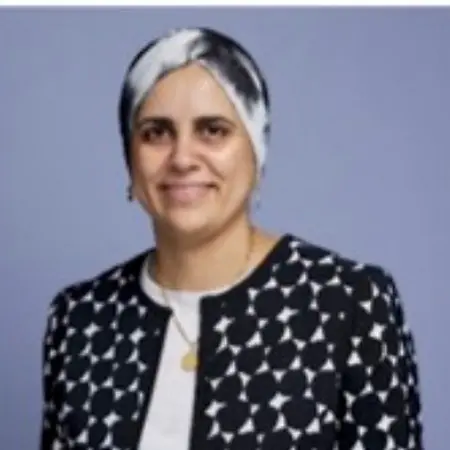
Her Story
About Chama
I came to the United States from Morocco knowing only a few words of English. Despite that barrier, I pursued my education and earned a bachelor’s degree, with honors, in Criminal Justice and Political Science from the University of Delaware.
After graduating, I volunteered with the CASA program, supporting children in the court system, and assisted victims and survivors in filing ex parte petitions in family court in New Castle County.
When my husband and I moved to Georgia for his job, I began working at a domestic violence shelter as an advocate. In that role, I saw that while women could access emergency shelter, there was often a critical gap in what happened next. Many survivors needed legal advocacy and long-term support to rebuild their lives.
Recognizing that need, I took action in the community and co-founded Noor Family Services with attorney Fakiha Khan. I chose the name myself—Noor means “light”—because I wanted to bring light into the lives of women facing crisis. We started with no formal infrastructure, no logo, and no established name—only a clear vision. I focused on program development while Fakiha provided pro bono legal services.
Through my work with survivors, I witnessed firsthand the profound difference that legal representation can make in the life of a victim of domestic violence. That experience inspired me to pursue advanced legal education at Emory Law School, where I earned my Master of Laws (LL.M.) in 2024.
During nearly 11 years of leadership at Noor Family Services, I remained deeply committed to providing comprehensive support to survivors. My work focused not only on legal services, but also on helping clients access housing, financial assistance, counseling, and other essential resources so they could build stable and independent futures. I have always believed in going beyond what the job requires—often staying after hours—because when someone comes for help, they deserve to be met with compassion and meaningful support.
I recently stepped down from my role as Executive Director and am taking time to reflect on the next chapter of my professional journey.
Her Interview
Ten minutes with Chama
01What do you attribute your success to?
I attribute my success to being able to change so many women's lives and seeing it firsthand. When women come to us, they come with the whole package - no job, no family, especially the immigrant and refugee population who don't even speak the language. As an immigrant myself, I know the barriers these women face in addition to being survivors of domestic violence. The most notable thing I can say is when I make that change in the life of a woman. They come to you hopeless, they come because the community let them down, and they found somebody who can hear them, see them, support them and help them. I go beyond and above my work - there's no limitation for me. If someone comes for help, I help them no matter what it is. Even after my work hours, I stay in the office and provide the services. I provide full services and connect them with other sister agencies for shelter, housing, furniture through Furniture Bank, education, certifications - whatever they need for their future. When you believe in the cause, you give everything in your heart. If you help one woman, you help her whole family, not only one woman
02What’s the best career advice you’ve ever received?
The best advice I’ve received is: “Build systems, not just services." Also to advocate for myself and to stand up in support of women, so I was focused on helping each survivor
individually—which is critical—but I learned that sustainable impact comes from creating structures that outlast you: strong programs, partnerships, and policies that continue supporting survivors long after a single case is closed
03What advice would you give to young women entering your industry?
Chase your dream and believe deeply in your cause. That belief is the foundation for everything. When you truly believe in what you’re doing, you give it your whole heart—and that’s what makes the difference. When I started Noor Family Services- nonprofit with the co- founder Fakiha Khan, I didn’t know anything about grants—how to find them, apply for them, or manage them. But I didn’t let that stop me. If I didn’t know something, I learned it. Today, we have so many tools and resources available, so there is always a way to figure things out if you are determined. You should also understand that it won’t be easy. You will face challenges, barriers, and setbacks. But if you believe in your mission, keep going. That belief will carry you through difficult times. I would encourage young women to trust their voice and not wait until they feel fully ready. This field needs leaders who are willing to step up, identify gaps, and create solutions. Stay grounded in the mission, but be open to growth—whether that means developing legal expertise, policy knowledge, or leadership skills.
04What are the biggest challenges or opportunities in your field right now?
One of the biggest challenges in the domestic violence field is securing consistent and sustainable funding. However, I view this challenge as an opportunity to be strategic and proactive.
Throughout my career, I have focused on diversifying funding streams and planning ahead. I have had strong success with fundraising initiatives, including community events such as spring tea gatherings, which not only raised funds but also engaged supporters in a meaningful way. While many organizations face funding constraints, I believe that with intentional planning and persistence, it is possible to meet those needs. This includes applying for grants, building relationships with donors, and developing creative fundraising strategies well in advance of each fiscal
year. My approach has always been to plan ahead and remain adaptable, which has allowed me to successfully secure the resources needed to expand services, including legal support for survivors. Ultimately, the opportunity lies in innovation—thinking beyond traditional funding models and creating sustainable ways to support critical services for the communities we serve.
05What values are most important to you in your work and personal life?
The values most important to me are having clear communication with the people you work with and supporting people who are working under you. If anybody comes to you, especially in the work life, you need to be a supporter for the people who are looking for help and assistance. I believe in being there for people who need support. I believe it is essential to create an environment where individuals feel heard, respected, and supported. Also, Integrity, compassion, and resilience are the values that guide me. As someone who has experienced the challenges of being an immigrant, I deeply value empathy and understanding. I believe in treating people with dignity and respect, while also staying resilient and committed to the work, even when it is difficult.
Join Influential Women and start making an impact. Register now.