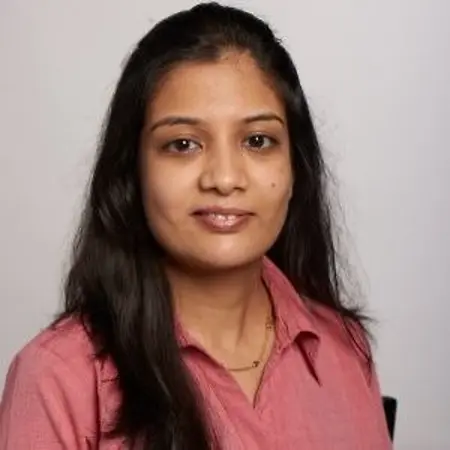
Her Story
About Charuta
I was always interested in science from a young age, even though my entire family came from accountancy backgrounds. I was the curious one who wanted to know why things happen, like why a painkiller stops pain. I had a science teacher in 7th or 8th grade who really inspired me and helped instill that curiosity, answering my questions and generating more curiosity about everything. She just passed away last week, and she was one of my inspirations to pursue science. My family wasn't sure how to support me in this path since they didn't know anything about science, but they tried to look for ways to help me achieve what I wanted to do. I come from a very small city in India called Kolhapur, Maharashtra, and today I work in the Greater New York area for one of the big pharmaceutical companies. My father wanted me to be a doctor, but I couldn't get into the medical seats because it was very competitive in India. So I chose the next step - if I cannot become a doctor and cure patients, let me go and find the cure that doctors use for their patients. I work as part of a drug development team where we assess the safety and efficacy of pharmaceutical candidates. We determine how much of a drug should be given, what the safe limits are, and whether drugs that work in the lab will actually work in the human body. We give the red or green signal before drugs go into the market. During the COVID-19 pandemic, I led a pediatric COVID biobanking project where we worked 16-17 hours together and set up a study overnight that normally takes months. We successfully biobanked pediatric COVID samples to understand why kids weren't getting symptoms, which provided answers for how COVID should be treated in adults. Studies from this work have been published in Nature Cell, which is a dream for scientists. I was lucky to be put in that position, and I'm proud of myself for making the most of that opportunity to serve not just one country but have global involvement.
Her Interview
Ten minutes with Charuta
01What do you attribute your success to?
My passion for science and the drive to cure disease has been my motivation. My father wanted me to be a doctor, which I unfortunately couldn't achieve because I couldn't get into the medical seats - it's very competitive in India. I didn't have the little push that was needed at that time. But then I chose the next step: if I cannot become a doctor and cure patients, let me go and find the cure that doctors use for their patients. That shift in perspective kept me going. I also had incredible support from my science teacher who instilled curiosity in me and answered my questions, generating more curiosity about everything. Even though my family came from accountancy backgrounds and didn't know anything about science, they tried to look for ways to help me achieve what I wanted to do. That family support was really important, even though they didn't know how to navigate this path. Because of that teacher and my family's support, I can proudly say I've achieved what I set out to do - I come from a very small city in India, and today I work in the Greater New York area for one of the big pharmaceutical companies as a scientist.
02What’s the best career advice you’ve ever received?
Believe in myself. And there is nothing that you cannot find an answer for. One of the most important pieces of advice I received was from my grandfather, who told me to always have the ability to start from zero. Today, if someone tells me I don't have a job or any money in my bank account, that I have nothing, I should have the ability to start from scratch. Knowledge is such a wealth that no one can steal it from you. They can steal your money, they can steal your job, they can steal your belongings, but you should believe in your knowledge - that I can restart from scratch and rise like a phoenix. That advice has shaped how I approach challenges and setbacks in my career.
03What advice would you give to young women entering your industry?
First of all, for every young woman out there, one piece of advice I would give is to be financially knowledgeable. I don't want to say financially free, because there are still some women who are dependent on their husbands or parents, but you should be knowledgeable. Second, just believe in your cause and what you want to do in the future. The way I worked is, for example, if I wanted to become a scientist, I would go and look for jobs for scientists, look at the responsibilities, and make sure I have them on my resume - not copy-paste them, but learn them and go find who can teach that. If you want to achieve responsibilities A, B, C, D, and not one person can teach you all of them, do a job for two years where you can learn responsibility A, then change your job to learn responsibility B. This way, you build the capabilities you need. Now my dream is to be in a director position overlooking all the assets, so what I do is keep looking at what a director does and try to learn from them in meetings. Listen to what they're saying, how they're saying it, what they know that you don't know, and how you can learn from them. Meet with them one-on-one and tell them they are your motivation. Ask how you can reach where they are - maybe it will take 5 or 10 years, but you want to get there. Can they guide you? Just go out there, ask questions, meet people, learn, and come out of your shell. You should never let someone say you're too old. There are directors at various ages, but you should always see where you began from. I began from a small city in India and came here. How many miles you traveled is also important, even if you haven't reached your destination yet.
04What are the biggest challenges or opportunities in your field right now?
The biggest challenge, to be honest, is that my field is very, very underpaid. We have to make a lot of compromises to be able to show up at work, because our work cannot be done from home - we need to be in labs doing things. But we are underpaid to the point where we cannot afford to buy lunch outside, so we work in the morning in our kitchens to make food for the family and then work in labs. Honestly, our field - the healthcare and lab side, not doctors or nurses or even the finance people in pharma - the lab people, the lab rats as they call us, we're very underpaid. We're not looking for money to go on vacations or to drive fancy cars, just to live. If we didn't have that worry in our minds, we could focus more on our work. For example, a scientist who can afford having lunch in the cafeteria can work more nicely and focus in the lab versus a scientist who is thinking about what they have to cook tomorrow. Our calendars are full - both home and work calendars - and sometimes we have to live far away because we cannot afford houses close to work. The quality of life for scientists, if they were paid what they deserve, would lead to a whole other level of drug developments and new techniques and therapies coming in. Talk to any person who is on the lab side in healthcare - one thing is for sure, we're really underpaid. I want to be the voice for this, not just for me because most of my career will be done by then, but for someone who is upcoming in the field.
05What values are most important to you in your work and personal life?
For me, working honestly and being loyal to what you do when no one else is watching are fundamental. Being organized and being punctual are also critical. If you have these values, you will never get into trouble and you will always find a solution to whatever problem you have. These four values are really a deal-maker or a deal-breaker for me. Even when I'm hiring people, even if someone has a little bit less knowledge, it's okay - I can teach them or impart that knowledge. But these values are inherent, and they all sum up to integrity. Integrity encompasses all of these things and is what I value most.
Join Influential Women and start making an impact. Register now.