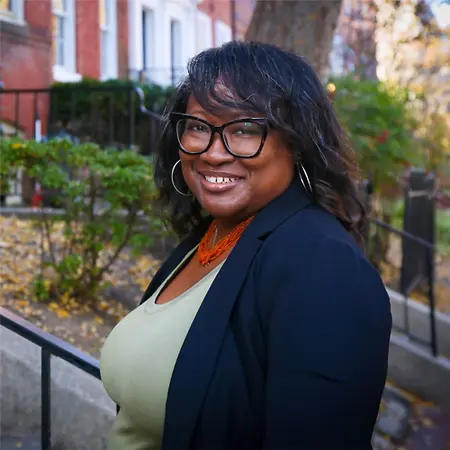
Her Story
About Jameta
I've always wanted to work on behalf of women as it relates to health, particularly Black women, Black families, and Black communities. There's a saying we have: if you make sure the woman is healthy in the family, most likely the family will be healthy. My great-grandmother died giving birth to my grandmother, and that story was told to me over and over. My commitment to particularly Black women, Black girls and women's health has stemmed from knowing this as a child. Everything I've done, whether it's federal government, with national nonprofits, or now in a university setting, has been about changing policy, improving education, as well as training the next generation of scholars who can contribute to Black girls and women's health, but broadly women's health and our larger public health that we need so much more. I'm a trained psychologist and women's health scholar, but my focus these days is primarily fostering joy in communities. I study intergenerational trauma, so right now I'm looking for how we can continue to develop strength-based approaches for optimal health for Black girls and women in largely Black communities. My everyday job is teaching - I'm a college professor. From day to day, I teach, I do research, I do community-based research, so I work with different communities, mostly in DC right now, and a little bit in Maryland, but I've worked all over, from Georgia, North Carolina, Maryland, DC, and Virginia over the years. Some days I'm teaching, some days I'm doing research with community at different stages of research, some days I'm working with students in my research lab. It really just depends.
Her Interview
Ten minutes with Jameta
01What do you attribute your success to?
Honestly, it's those notes that students give me at the end of the semester about how they found their voice in my class. I've won federal awards, I've won national awards, and I've written a book, but what I'm most proud of is the impact I have on my students. I had students email me after they graduated last year - I met them in my class their freshman year. I had talked about how when they go home that first time after their first semester in college, everything seems different, but it's just that they're growing and changing. These students became really good friends, and they would hang out at cafes, and they told me what I said in that class - and I don't remember saying it - apparently really changed their lives. I think knowing that I have that kind of impact on people, and I have students out here doing amazing things, it just feels like I'm doing my part to change the world. So I think I'm most proud of that.
02What advice would you give to young women entering your industry?
I'm very interdisciplinary - my undergrad's in English with a writing minor, and I have a public health degree, and then I have a psychology degree. For a lot of my mentors, they were just like, what are you doing? That's all over the place. But if something makes sense in your head, I do believe we're all given purpose. So if something makes sense in your head, just go with it. Because it all makes sense in my head, and I've been able to just engage in so much, and I can really appreciate and see how they were all wrong - it all came together. That would be my biggest advice: if you have a vision, and it might not be - I won't say it shouldn't be out there, like it's not too far out there - but it should be just enough to scare you. You should do it, because that's how we grow.
03What are the biggest challenges or opportunities in your field right now?
People don't believe in science. The people running our current administration don't trust what we know in science and women's health. A lot of my colleagues that I've worked with in government have been fired, and I don't think people realize what that means to science - to not have that continuation of knowledge, institutional knowledge. Usually in federal government, public health is related to federal government, so the attack on public health has really set us back, maybe 30 years, that I don't think we're talking enough about, particularly for women's health. What you're seeing is that people are now doing what we did during Reconstruction, where communities are taking care of themselves. You see a lot of women's collectives making sure people have food, making sure people have access to healthcare. We're going to see more of that - you're going to see more community-based health, not the fancy kind, but the kind like, look, you don't have health insurance? Come to this clinic, we can provide this care. What the Black Panthers did in the 60s. But it's going to be worse, particularly for so many folks who've been laid off and don't have jobs. We are a country where our healthcare is dependent on being employed.
04What values are most important to you in your work and personal life?
The grounding I got from my parents has been most impactful. I went to Spelman College, and that grounding, and all these amazing people I've met along the way, gave me insight. But I think also the most impactful are books. We don't talk enough about how books really take you places. They took me places in the library - it was before Google. I would hang out at the library growing up, and I really got to see the world. My mom and I would literally sit in the living room multiple times during the week, and we would read together. I was restricted to TV only an hour a day, so we would just sit there and read together. That's just what we did. We still do. My parents fostered that - I used to ask questions to my parents, and they sent me to the encyclopedia. So I would say the most impactful would definitely be books and the foundation my parents gave me.
Join Influential Women and start making an impact. Register now.