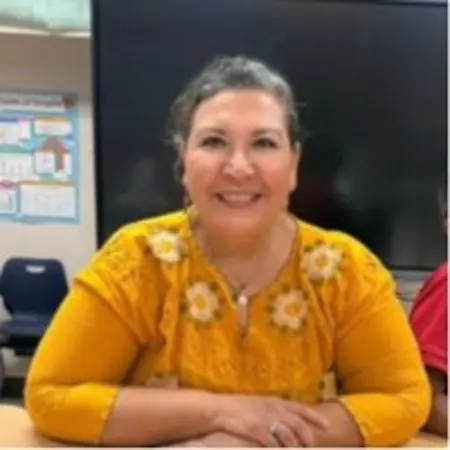
Her Story
About Judy
Judy Zapien, MA, Ed., is a bilingual education specialist in the El Paso Metropolitan Area currently serving with Las Cruces Public Schools. She specializes in data-driven IEP development, bilingual literacy instruction, and academic support for multilingual learners, with a strong focus on equity, access, and 21st-century career readiness. In her current role as an elementary bilingual education specialist, she teaches English and mathematics to students ages 5–11 while ensuring that each student’s individualized academic, social, emotional, and behavioral needs are met in alignment with their legal educational plans.
At the heart of her work is a commitment to creating a safe, welcoming, and supportive school environment where students feel valued and encouraged to succeed. She strives to be a consistent role model of strong character, responsible citizenship, and positive decision-making, helping students build confidence and resilience in and beyond the classroom. Judy brings a deeply student-centered approach to education, grounded in empathy, consistency, and high expectations, and she is known for supporting learners through both instructional excellence and meaningful relationship-building.
Beyond her classroom practice, Judy is an active advocate for bilingual education and has been invited to lecture at Stanford University on multiple occasions focused on EL advocacy. She has also presented at conferences hosted by the California Association for Bilingual Education, contributing to broader conversations on multilingual learning and equity in education. A musician and singer, she incorporates creativity and expression into her work, encouraging students to explore their talents and voice. She is also developing ideas for inspirational children’s literature that uplifts children of color, including stories that address equity in access and representation, such as a narrative about a young boy learning to swim.
Her Interview
Ten minutes with Judy
01What do you attribute your success to?
I think that I learned as a very young child that hard work was taught at a very early age in my home. I was the oldest child, and I think that has to do a lot with the upbringing that I received. The other thing is that all of us in our home contributed to the objective of the household. What our parents taught me, or taught us, was to be able to share amongst each other, and not just be, oh, well, I'm by myself, I'm gonna have this, or I'm gonna have my own thing. I think it was to be able to share and to be grateful for what we had.
02What’s the best career advice you’ve ever received?
I could say there's two pieces of advice that stand out. When I was working as a family engagement coordinator and EL coordinator in San Diego, I asked my principal or director, Dr. Caleb Rashad, how can I provide better services to our community, and he said, 'Amplify.' Just amplify what you're doing. That meant to expand, to be able to ask questions, to be able to market, to be able to make connections that were worthy or that needed that support, that needed that service at that time. Amplify who you are, amplify the needs of the organization, amplify what we do as an organization, with, of course, amplifying the skills and the talents that the organization provides to better serve the community. Number two, as a teacher, I think one of the best pieces of advice is to be the one who notices. Be the one who notices what the child does, whatever, meet the child where they are and be the one who notices. That quote was said by Dr. Rob Reardon, who is the founder of High Tech High.
03What advice would you give to young women entering your industry?
Something that I've learned over the course of my 20 years is that in education, the former leaders, the previous leaders, were males, and now what we see in education is that most of the leaders now are women. I believe that we should amplify and should be able to use and utilize those female-specific female characteristics that we have, say, for example, that maternal instinct we have, the grace, being able to be great listeners, to listen with empathy. As we go up in the ladder of success or rise into the ladder of leadership and executive roles, we must not forget how hard it was, especially being a woman of color like myself, to be able to scaffold through and to break through all those barriers that we had to get to the level of success. We need to be grateful and to be able to have dignity and grace and humbleness to be at that high level of leadership, because that's a privilege. If you are a CEO of an organization or if you are in a position of leadership, it's because you, one, earned that role, number one, and people believed in you to represent that role and to represent a body of people. So if you are in that role, you must not forget how you got there, number one, but number two, to be able to have that humbleness to continue to grow and become a better leader that has empathy, that is able to be a great listener, to be able to take feedback gracefully and process it, ruminate on it, write about it, reflect on it, and ask how did that group of people make me grow. When you allow yourself to grow, then in the long run, I think that your organization also grows, because then you're being able to cultivate the importance and the roots and the mission of the organization.
04What are the biggest challenges or opportunities in your field right now?
There are new teachers coming in who are much younger, and Generation X is retiring. What really concerns me about new generations coming into the industry is exactly those things that I was talking about, and that is, number one, just not forgetting to say good morning, not forgetting to say thank you, not forgetting to say hey, we are collectively working together as a team, you are not by yourself. Teaching is a team effort, because if you cannot work with other fellow educators, your school is going to fail. I think that as a leader, being a principal, a coordinator, being in a position of leadership, you have to be able to bring people together. You have to be able to remember to have people trust you as a person, number one, and to be able to trust in the leadership that you're bringing to the table. Dr. Rashad was one of the most amazing leaders that I had ever worked for, and he brought to the table what was a very simple word, and that word was love, L-O-V-E, because with love, it embodies so many important aspects. I'm very concerned about what is being brought into the education system by the newer generations, but I think that we as older role models are able to bring that to the table and we're able to share by showing them how it's done, by little things that we can do, just a good morning or hey, have a good day at the end of the day, or hey, I see you're struggling with this kid, how can I best help you.
05What values are most important to you in your work and personal life?
One of my most core values is being able to have grace when something is difficult, you know, not everything is gonna be easy. And that takes a lot of work over the years, is to be able to have grace, to receive good criticism or good feedback from your coworkers or your supervisor, to be able to have grace to ruminate on it, to digest it, to reflect on it, and then to come back and debrief to your coworkers, to your supervisor, or say, hey, you know what, thank you for allowing me to grow with your words, with your experience. I think that communication, to be able to communicate in a respectful way, and to also have some kind of protocol to be able to speak to other people is extremely important, so there can be grace and there can be respect, and so that people can move forward towards the mission of the organization.
Keep Exploring
More Influential Women · New Mexico





Join Influential Women and start making an impact. Register now.