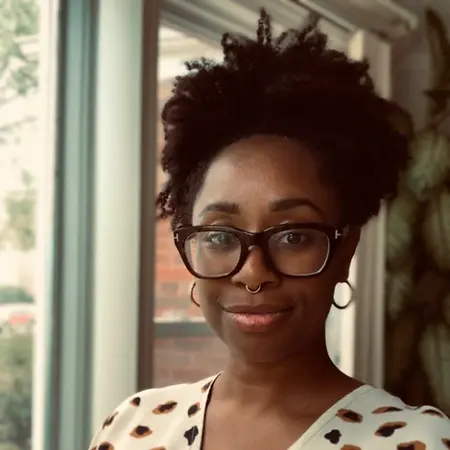
Her Story
About KIMBERLY
I've been in the architectural industry formally since 2012 when I started grad school, and I currently work at Jack Corp, a boutique architectural firm where I've been since 2021. My role as Interior Design Lead Project and Project Manager allows me to touch on many different project types and parts of the process. I focus on custom residential interiors, but I also work on historic preservation, as well as retail and restaurant work, both new builds and renovations. Because we're such a small firm, I'm a really good generalist. What I love most is that initial pre-design meeting with the client where I gain a better understanding of what their needs are, which makes it easier to provide them with what they need. My background as a trained dancer in ballet, jazz, and modern dance has deeply influenced how I approach design. I've always appreciated the way we move throughout space and how our bodies move regularly, and the healing that can do. When I look at projects, my first focus is spatial planning and how things flow and move together, because how we experience space as the end user is what I consider the definition of what is successful or not. It's not just how beautiful a building might look or how grand it might be, but rather the experience inside and around these spaces. For schools, I want students and teachers to feel encouraged to learn and teach. In homes, I have a whole formula I use to help encourage the feeling or the way people are supposed to move in and through different spaces. That's really what guides how I've designed things, and how successful they are is based on how the end user is feeling and experiencing space and moving throughout it.
Her Interview
Ten minutes with KIMBERLY
01What do you attribute your success to?
I would attribute my success to my support group, my community, and being reared and encouraged to go after what I desire and what I want. My mom went to school for engineering, and seeing how she used her skills initially and then how it transformed after she had children was really influential. My dad was a draftsman who worked in industrial design, and watching him showed me what it looked like to be able to take an idea from your mind, draw it out on paper, and then see how it can be built or created in real life. Because he was in industrial design, I was able to see that in many different forms outside of the built environment, which was very enlightening and encouraging for me to know that all I have to do is know how to put the things together, and I can create anything, because I already have the ideas. Watching how my mom's skills transferred from engineering to teaching after having children, and seeing how my dad was able to use those tools, helped to encourage me to be able to achieve or go after anything I desired, and I chose architecture.
02What’s the best career advice you’ve ever received?
The best career advice I received was when I was graduating from U of I as a grad student. One of my coworkers congratulated me and said, 'Don't accept any wooden pennies.' I learned that way back when, enslaved people were given wooden pennies as payment, which was a lower value than a penny and only accepted by certain places. It basically means don't accept less than what you're worth. That has always been very important and helpful when coming to a table to discuss fee with a client or with your employer. Oftentimes we let the people around us be our sounding board on that, and that's helpful, but my experience is my own and your experience is your own. You identify what your value and your worth is. While somebody may not be able to pay you what your value is, you can say I'm going to work for this, however I know this is my value. Know what your value is and move accordingly, and don't overwork yourself where that's not serving you.
03What advice would you give to young women entering your industry?
One of the biggest things is to have a community or collective of people, mentors, or people who have your back and can be a sounding board as you're going through these different experiences. And two, recognize that you're in places where historically you haven't seen people who look like you, so you have to trust yourself and the decisions that you make and continue to move forward. Nothing is going to be provided to you. You have to declare those things, you have to make it happen. You can't expect that someone's gonna do that for you.
04What are the biggest challenges or opportunities in your field right now?
With architecture, there's this issue with value. People don't really understand the value of an architect, so when it comes down to cost and pricing, it's always this big thing because the value of an architect and their skills are kind of simplified to being able to draw lines on paper when it's so much more than that. One of the biggest things that needs to be done is re-evaluating how we're packaging our value to the outside world so that we can be able to get paid what we're worth, and taking that power away from this large overhead structure of architectural firms and putting it into the hands of the designers and the people that are putting these projects and buildings together. For women, architecture can be a time-consuming profession because the design process is not formulated in a very easy way, and that can show itself to be difficult for parents of children, especially in those early years. If you're not committed to this continually over time, you can find yourself in a backburner position, so it requires you to be more advantageous and on top of your career decisions while simultaneously being able to provide for your family and home life. Work-life balance is something that we are getting better at, but it's still something that needs to be managed, and that translates on the professional side and is still something that's seen very clearly while in school. The way that we approach work and design needs to be more balanced. Also, we're not looking at architectural history's total input, we're only looking at a very small group of architectural history to influence the profession. I think we need to re-reflect or review what is being studied when we're in school to help support where we're going and where we are now.
05What values are most important to you in your work and personal life?
I grew up as a dancer and was trained in ballet, jazz, modern, all of those things. I have always appreciated and loved the way that we move throughout space and the way that our body moves regularly, and the healing that can do. When I look at projects and look at things, my first focus is looking at spatial planning and how things flow and move together, because how we experience space as the end user is what I consider the definition of what is successful or not. For me, it's not just how beautiful a building might look or how grand it might look relative to me as a small person. What I want is the experience inside and around these spaces meeting the goal. For schools, do students and teachers feel encouraged to learn and to teach? What are the methods and things that we are doing to make these spaces supportive of that? In the home, I have a whole formula that I like to use to help encourage what the feeling or the way people are supposed to move in and through different spaces. That's really guided how I've designed things, and how successful they are is based on how the end user is feeling and experiencing space and moving throughout it.
Join Influential Women and start making an impact. Register now.