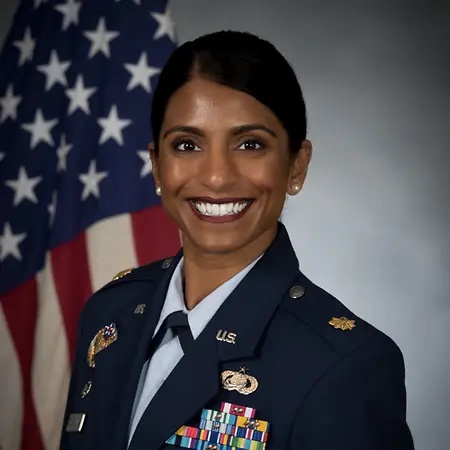
Her Story
About Krystal
My journey to the Air Force began as an immigrant kid whose parents came to the United States in the 70s and 80s with no military background whatsoever. Watching my family fight to come to the States and seeing their pride as Americans, going through the citizenship process, made me think a lot about what my life could have been if I wasn't an American. We go back to India quite a bit where my grandparents are Christian missionaries living in a little village, and I think about how if we never left, I probably would have been a young lady growing up in a village without the same opportunities. When I was going off to college, my mom said I needed some discipline in my life and should either do lacrosse or look into ROTC. I didn't know anything about lacrosse, so I tried ROTC and landed on the Air Force because it seemed more family-friendly and conducive to the future I was hoping to have. Now I serve as the 23rd Force Support Commander with about 500 civilian and military personnel under me. The military has taught me to be adaptable and given me the breadth of experience to become a jack-of-all-trades, constantly learning through different locations, mission sets, and types of jobs every two years. My day is spent collaborating, making decisions, coaching, and encouraging my team, always ready for any emergency or fire that comes up. I lead with the values of being humble, approachable, and credible, and I believe in leaving the world better than you find it by choosing kindness and saying kind things behind someone's back to show you're advocating for your teammates.
Her Interview
Ten minutes with Krystal
01What do you attribute your success to?
Seeing how my leadership positively impacts my team at the organizational level and individually - a big part of that is knowing who I am, staying true to myself, and refusing to let the world talk me out of it. I simply want to leave the world better than I found it, and if the unit and the individual are better served, feel seen, heard, understood and valued - that is success.
That sounds simple, but it’s been the hardest and most important work I’ve done. The military has taken me through environments that could have easily reshaped me into something smaller, something more convenient. What kept me grounded was a commitment to my values — not as words on a wall, but as daily decisions. Choosing kindness when criticism was easier. Choosing courage when staying quiet would have been safer. Choosing humility when ego would have felt more comfortable. These things in combination are experienced by the people I interface with every day. If they are better because of me, then that’s success.
I also attribute success a lot to the willingness to be uncomfortable. Every two or so years, I was handed a new mission, a new team, a new version of a challenge I hadn’t faced before. I could have resisted that — a lot of people do. Instead, I leaned into it, and what it built in me was an adaptability and a mental agility that I genuinely believe no classroom could have taught me.
02What’s the best career advice you’ve ever received?
Trust yourself.
It sounds simple, almost too simple for how much weight it carries. But as I’ve moved through my career in the Air Force, the moments where I’ve questioned myself most weren’t the ones where I lacked skill — they were the ones where I stopped listening to my own instincts. The advice that changed that for me was this: don’t change your core. The world will try to jade you. The pace, the politics, the weight of service — it can slowly erode the clarity of why you started. The best thing I ever did was anchor myself back to my values every time I felt that drift.
When I ask myself am I doing this right, the answer has never come from outside me — it’s come from checking back in with who I am and what I believe. Authenticity isn’t a starting point you leave behind as you grow. It’s something you return to, again and again, as the standard you hold yourself to. That’s the advice I carry, and it’s the advice I give: stay true, keep growing, and trust that the values you’ve built are enough to lead you well.
03What advice would you give to young women entering your industry?
Know your worth — not as a mantra, but as a practice. Know it so deeply that it becomes the ground you stand on when the room feels like it wasn’t built for you. In a field where 80% of the people around you may look different from you, it’s easy to start editing yourself — softening your voice, shrinking your presence, performing a version of yourself that feels more palatable. Don’t.
The world doesn’t need a version of you that was designed to make other people comfortable. It needs the full, unfiltered, credible, kind, strong version of you. If a space requires you to abandon who you are in order to belong, that’s information — and it’s telling you that your energy is better spent elsewhere.
Invest in knowing yourself. Not just your strengths, but your edges, your blind spots, your values. And then get comfortable being uncomfortable, because growth doesn’t live in the easy places. The moments that stretch you — the ones that feel impossible before they feel inevitable — those are the moments that show you what you’re made of. Pursue them. Sit at the table. Take up space. The world’s your oyster, and no one else gets to decide how much of it you claim.
04What are the biggest challenges or opportunities in your field right now?
The military gives you something most careers can’t manufacture: forced growth. Every two to four years, you step into an entirely new job, a new location, a new mission set, and a new team. There’s no asking for it — it’s simply the culture. That constant context-switching builds a mental agility that I think is genuinely rare. You learn to read rooms, lead different kinds of people, and adapt to environments most professionals never encounter. That breadth of experience doesn’t just make you a jack-of-all-trades — it makes you someone who can walk into almost any situation and find your footing.
The challenge lives in the same place as the opportunity: the mobility. Stability — the kind that comes from roots, long friendships, a community you’ve built over years — that can feel out of reach. But here’s what I’ve come to believe: military people find each other fast. When someone knows you’re military, there’s an unspoken shorthand, a depth of understanding that accelerates connection in a way civilian life rarely does. The relationships may be shorter by the calendar, but they are rarely shallow. You don’t need longevity for something to be meaningful.
05What values are most important to you in your work and personal life?
Everything I do is rooted in kindness — not the surface-level niceness that gets mistaken for it, but the kind of kindness that requires intention and courage. There’s a profound difference between being nice and being kind. Nice is passive. Kindness is a choice you make even when it’s hard, even when no one is watching. I tell my team: say kind things about people behind their backs. Because the truest measure of your character isn’t how you treat someone to their face — it’s whether you advocate for them when they’re not in the room.
But kindness without structure can drift. So I pair it with temperance — the ability to be measured, level-headed, and as unbiased as I can be in any given moment. I pair it with courage, because it’s easy to stay in the background of a story. It takes something more to be willing to do the hard thing. And I pair it with wisdom — responding thoughtfully rather than reactively.
And then there’s what the Weapons School calls the trifecta: humble, approachable, credible. I borrowed that framework and never let it go, because I believe it’s universal. It transcends rank, industry, and role. If you show up that way every single day, you’re not just a good leader — you’re someone who makes the room better just by being in it.
Join Influential Women and start making an impact. Register now.