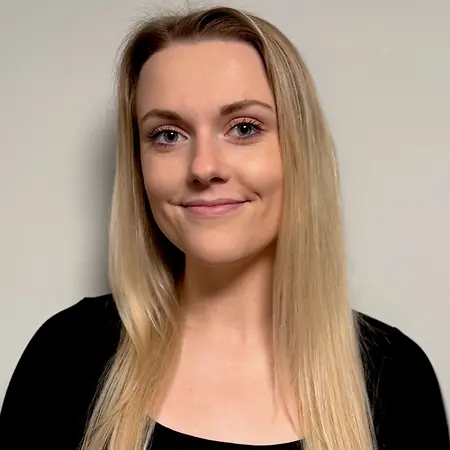
Her Story
About Lisa
My journey in science began in Germany, where I grew up between Germany and Ireland. I was always curious about why things happen, especially diseases, and knew early on I wanted to work in the medical field. After trying internships in veterinary medicine and hospitals, I realized I loved the science but found the direct patient suffering difficult. That's when I discovered biomedical research. I completed my bachelor's degree at Bonn University, about half an hour from Cologne, studying a combination of physics, chemistry, and biology that led to specializations in immunology, biochemistry, and physiology. When I met my husband, who is American, I decided to pursue my PhD internationally. I was fortunate to be accepted at St. Louis University, where my tuition was covered, which was crucial given the cost differences from Germany. From 2019 to 2024, I worked in Gina Yosten's lab, researching diabetes with a specific focus on the pancreas-brain connection and what goes wrong in insulin-substituted patients. I managed our large rat colony, handling breeding and genotyping while ensuring genetic diversity for statistical relevance. Working so closely with animals for years made me question the ethics of animal research, even as I tried to give them the best care possible. This led me to the International Foundation of Ethical Research (IFER), which funds novel projects using human tissue or clinical samples instead of animals. I was honored to be accepted onto their Scientific Advisory Board, especially given my limited non-academic work experience at the time. Completing my PhD after five years was incredibly satisfying, particularly bringing all the research together to tell a coherent story. Now I'm actively pursuing opportunities in industry in the St. Louis area, connecting with organizations like Bayer and the ACTEC Center.
Her Interview
Ten minutes with Lisa
01What advice would you give to young women entering your industry?
Don't let imposter syndrome stop you, because the fact that you're thinking that way already shows you're so much smarter than you think. If you're aware of how much is out there that you don't know, that actually demonstrates how intelligent you already are in the first place. I've seen so many bright people in science who thought they weren't good enough to be here, that everyone knows more than they ever will, and everyone probably thinks they're dumb. That's such a sad thing because there are so many brilliant people going into these fields. In science especially, the more you learn, the more you see how much there is that you don't know, so it's logical that the more you learn, the more scared you get. I really empathize with that feeling. I wish everyone in every field would know that half the time when someone looks like they've got it all under control, it's just because they're faking it till they make it. No one can know everything, and that's actually a good thing because that's how we exchange ideas and learn from each other.
02What values are most important to you in your work and personal life?
One of my major values is transparency and doing research for the greater good without majorly crossing the rights of other organisms. My core value is to treat every organism with respect. I understand it's not always possible to give everyone the same treatment we give humans, because the world would go insane, but I always keep an appreciation for the lives that are given to us for research by those animals in the back of my head. That humbles me as a researcher and scientist. I also deeply value the fact that in science, you can't do anything by yourself - you need a team. No one knows everything, and it's good that no one knows everything, because that's how we exchange ideas and learn. I'm still working on not internalizing this too much, because it can be close to imposter syndrome, but realizing that no one can know everything is important to me.
Join Influential Women and start making an impact. Register now.