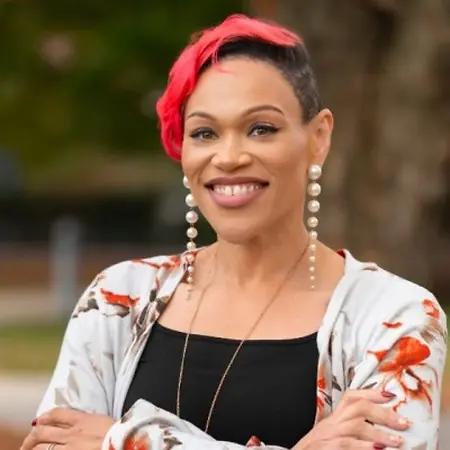
Her Story
About Rachel
I work in higher education, specifically in student affairs as the Assistant Director of Experiential Learning in the Office of Career and Professional Development at Southern Connecticut State University. What that means is I help students conceptualize how whatever experiences they're having at the current moment contribute to their career goals, and I curate different programming and events that support that. I collaborate interdepartmentally with the faculty side and other departments within the organization to create experiences for students, whether that be workshops or programming that targets certain students within different majors, or for instance, first-generation students or students on probation. I create professional development opportunities for student workers and for students having experiential learning opportunities like mission trips, study abroad events, and I also create professional development opportunities for student worker supervisors to keep them updated on various changes and to assist them in curating different positions or reimagining what their department could look like with different student workers. Before coming to higher ed about 6 years ago, I was in nonprofit for many, many years doing workforce development management. I worked specifically with students who were on probation and parole, as well as students who were overage and undercredited in alternative schools, doing wraparound services, providing internships, and workforce development training. I transitioned into a director role where I did a lot of work with students and youth who were displaced, created programming to do wraparound services in schools to provide mentorship and case management, and I managed and directed a re-entry program. I transitioned to higher education because although I loved what I did in nonprofit, it did not pay me enough, and I was married and pregnant with my first child at that point. I was looking for another opportunity that could still feed my soul like nonprofit but also feed my pockets. I specifically chose Southern Connecticut State University because of the social justice aspect of their mission and because they service students who have a high population of students of color, about 50% of the students are students of color, high Latinx, high first-generation population. It was like a marriage between the individuals I serviced and fed my soul within nonprofit and what I wanted to do to feed my pockets and continue on with my career development.
Her Interview
Ten minutes with Rachel
01What do you attribute your success to?
I honestly have had other women in my life that I've seen do it throughout their lives. That's a big contribution to me - my mom, my aunt, my pastor, who is a woman. I've seen other very strong women that have contributed to me believing that I really can do anything. My mom was widowed when I was [AGE], and at that point my younger sister was 6, my older sister was 10, so she had 3 girls. She raised us really strongly, like, listen, I'm not saying you have to be super independent, but don't be codependent. You can do things, you can have your own things. She just instilled having your own, and just seeing her do things, buy, you know, own her own home, would be the single purchasing, you know, working when she had to work, but she never missed anything. I was never into sports, because I was like, anything that I could sweat, I didn't want to do, but all my National Honor Society, all of my things where I was contributing to advocating or whatever in the community, she never missed those things for me and my sisters. She never missed those things, so seeing her do it all and make it work in my mind, it's still, you know, I can't fathom, because I'm doing it with a partner, with my husband, and she did it by herself. And then my aunt, my pastor, who is a woman, it's just seeing other women stand strong in their paths, and letting me see an image of who I could be is, I think, paramount, and has been paramount in my experience. I hope, truly, that I am that for other women, and that's one of the reasons why I even started mentoring in my early 20s, because I wanted other women to see other women out there. We are a village for each other. We do not have to be against each other, we can uphold each other and see you from afar, and know that when you are succeeding, we are all succeeding. And then when I succeed, it's also your success and your win. It's an us thing.
02What advice would you give to young women entering your industry?
I would say two things. First, I would say never reject yourself. So many times, I feel like, especially in career, people look at jobs, or look at opportunities, or look at things, and they say no to themselves before they even put themselves out there to get the no. I say that because the biggest regrets usually people have in their lives are the things that they don't actually go after. So, if you go after it and then you don't get it, at least you know definitively if you got it or not, or you'll learn something from it to move forward and do things differently the next time. So that's my first - never reject yourself, never be the person to say no to yourself, go after it, and then see what happens. The second one, and this specifically I feel like it's for women of color - so many times we look at people who have or we become the people who have, but we don't remember who we used to be. And I would say always look back and give a hand up. When you see an issue, or when you see things that you did not like when you were coming through the ranks, don't be that. Do not be that. One of my biggest things is I'm always, I feel like I lead when I supervise now, too. I always considered myself, like, an empathetic leader, because you can get to know someone, and someone is not just their work self. Find out who they are. Are they, do they have a family? What makes them proud? What makes them want to, what do they want to develop? Just get to learn people, build a rapport with people. A lot of individuals don't lend a hand, or don't see where they've been, and then give back. They just become the same thing they always seem. Be the thing that you wish you would have had.
03What are the biggest challenges or opportunities in your field right now?
A lot of the gaps that I see, specifically in higher ed, are we don't necessarily always look at the full student. We expect them to perform, perform, perform academically when they're not well on every other aspect besides academics. So if they're not doing well on other things, you know, there's going to be things that they don't do well academically. Having a more holistic approach to higher education and focusing on how we can fill those gaps for the students that need the gaps filled and become more, have a more equity lens is something that I'm working on with that. My goal with my doctorate in counselor education and supervision is to be able to transform education. I've always come with advocacy. When I came into higher ed, my thing was, you know, how can I come over here and make it better? What things and what gaps do I see?
Join Influential Women and start making an impact. Register now.