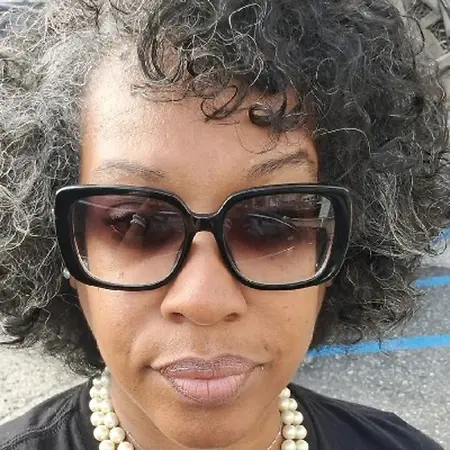
Her Story
About Tabitha
I've been in the field of psychometrics for nearly 20 years now, and my journey has been filled with many firsts. As a Black woman, I've been the first in a lot of spaces, and often the only one in many rooms. My story is unique because I entered graduate school as a mother with young children when I started my master's and PhD program. I was raising children and switching careers at the same time, which gave me a very unique vantage point. I want young women to know that you don't have to choose between building a career and being a mother if that's what you choose to do. You don't have to prioritize one over the other - they can occur for you concurrently. I was very active in my children's PTA, serving as secretary and running Teacher Appreciation Week, all while running statewide assessment programs. One teacher even thought I was a stay-at-home mother because of how active I was at school. That's the legacy I want - to be an example to young women entering the field that there is space for you, you just have to speak up and become your own best advocate. Today, I check in daily with the database and task orders for the National Center for Education Statistics, monitoring congressional updates and mandates from DC that need implementation in New Jersey. I advise the commissioner and governor's office on priority items affecting our entire state. As the first Black woman president of the National Consortium and State Educational Research Associations, I have the incredible honor of helping spearhead leadership for all regional and state educational research associations around the country. I love that I'm in a space where I have the ability to impact public education, because I am a product of public education. I was a free lunch kid, a high-achieving, low-income student, and now I'm able to use data to help students like me get the most out of the public school system, not just in New Jersey, but nationwide.
Her Interview
Ten minutes with Tabitha
01What do you attribute your success to?
I attribute my success to having my maternal grandmother, Hazel. She was just a very strong woman who persisted against all odds. She earned a college degree with 10 children, as a divorced single mom in a society that was very anti-divorce, anti-single women. She had to get a cosigner to get an apartment, she had to get a cosigner to get furniture, she had to go to school at night, and she just refused to quit. She was beautiful, and people would always comment on how beautiful she was, and she would say, if you think I'm beautiful, wait till you see how brilliant I am. She would always say, it doesn't matter how pretty you are if you open your mouth and you're dumb. Those kind of things always stuck with me, that being brilliant is more important than anything else you could offer.
02What advice would you give to young women entering your industry?
I would tell young women entering my industry to pay attention to detail. Pay close attention to every detail, because the numbers matter, the values matter, the data matter. Because it is a traditionally male-dominated field, when there are women there, the face is changing a bit, but sometimes, especially when a woman is very beautiful, there's like a little question, like, are you really smart enough to be here, or did somebody do a favor to get her in these programs? So pay attention to detail, making sure that their data is always error-free to the best of their ability, so that they can always go and defend their work, and there will never be a question that though they are beautiful, they are more brilliant.
03What are the biggest challenges or opportunities in your field right now?
The opportunities in my field are incredible because testing is everywhere, testing is not going away. As long as there are tests, there will be psychometricians. And because psychometrics is a combination of psychology and advanced statistics, there's so many opportunities for me to go anywhere and do anything. I'll always have a job. I could work until I die. One of the biggest challenges in this current environment is the attack on intellectualism, and there's an attack on the integrity of data. Data are being discredited, so that people can actually collect valid and reliable data, they can present the data and say, here are the facts, the numbers aren't lying, here are all the tests, and somebody with no education could say, that's not true, that's not real. Here's what I think, here's what I heard, here's what I read in some op-ed that somebody who barely graduated high school came up with, and a group of people would decide that's the proof. And they'll discredit and discount the facts and the science and the math behind what's actually true. To me, that's the biggest challenge, and that's what we all in my field are facing right now.
04What values are most important to you in your work and personal life?
I would say honesty and integrity are most important to me, especially because I work with data and statistics. I know that people can use statistics to manipulate them, to tell whatever story that they want, even with nefarious outcomes. So I believe that honesty and integrity are the two most important characteristics, especially pertaining to data. Because I work in public education and I'm a civil servant, these are people who traditionally are marginalized and most disenfranchised. They are powerless against some of these systems that can be oppressive towards them. So it's important that those of us who have the positions where we are able to impact change are working with the utmost character, have a high moral compass, and seek to do things that are honest and work with the best outcomes for those who rely on us.
Join Influential Women and start making an impact. Register now.