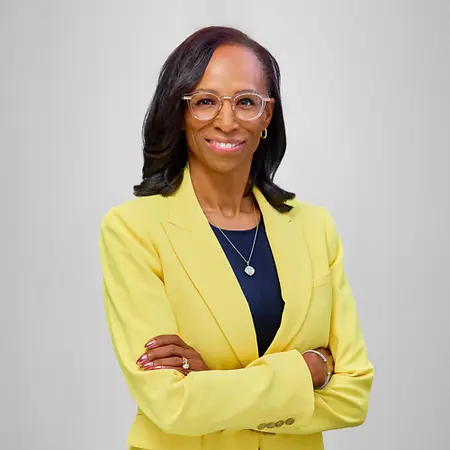
Her Story
About Tracy
Tracy Doaks is a respected technology executive, public servant, and strategic leader with nearly three decades of experience driving innovation across the telecommunications, healthcare, government, and nonprofit sectors. As President and CEO of MCNC, she leads the organization responsible for providing critical network connectivity to every K–12 school in North Carolina, while also supporting higher education institutions, community colleges, and research organizations throughout the state. Known for her expertise in technology strategy, cybersecurity, governance, risk management, and operational leadership, Tracy oversees more than $70 million in annual revenue while advancing initiatives that expand digital access and strengthen North Carolina’s technology infrastructure.
Before joining MCNC in 2020, Tracy served as Secretary for Information Technology and State Chief Information Officer for the State of North Carolina, where she led statewide cybersecurity, broadband infrastructure, data analytics, 911 services, and strategic IT planning. Her career has also included executive leadership roles with Duke Health, the North Carolina Department of Revenue, and Blue Cross NC. A graduate of North Carolina State University with a degree in Industrial Engineering, Tracy has continued to expand her leadership expertise through executive education programs and board governance certifications, earning recognition as one of North Carolina’s most influential technology leaders.
Throughout her career, Tracy has remained deeply committed to public service and creating meaningful impact through technology. She is passionate about closing the digital divide, particularly in rural and underserved communities, and believes that connectivity is the foundation for opportunity in education, healthcare, and economic development. Serving on numerous boards and advisory councils, she is known for bringing people together, building strategic partnerships, and leading with integrity, accountability, and purpose. Her contributions have earned numerous honors, including North Carolina State University’s Distinguished Engineering Alumni Award and multiple leadership recognitions celebrating her influence on technology, governance, and community advancement.
Her Interview
Ten minutes with Tracy
01What do you attribute your success to?
I think some of the important things for me that have helped me be successful are grit and resilience, because it's hard. Technology itself is hard. What's even harder is working with people, so you know, grit and resilience to be able to make some sacrifices sometimes, working through setbacks. The second thing is emotional intelligence. We all have to master our emotions rather than being ruled by them, and if you're not able to do that, you're really going to struggle in this industry. You have to really have that ability to read people well, and use that evidence to make decisions, and to stay composed in those conversations even if you were a very emotional person. And third, boundaries and energy stewardship. Being able to say no when you need to say no, being very protective of my time to ensure that I am productive. I am not one of those people that has a very jammed schedule all day long, because I know for me personally, that is not good. It's not good for my mental health. It's not good for my physical health, and I learned over the years, I do have to pay attention to wellness. And what makes me successful in the work that I do, is I always have assistants that are protective of my time and protective of me personally to understand, oh, my goodness, let me make sure she's got these breaks to eat, because if she doesn't eat, she's gonna fall down at 3 o'clock. Setting those boundaries, and someone to help me with those boundaries, as well as I go through day-to-day, I think, have been important. So, I think those three things have really helped make me successful in the work that I do.
02What’s the best career advice you’ve ever received?
The best career advice that I ever received from my mentor, who is still my mentor today, was to find your tribe outside of work. You have to have a support system, particularly for women, because we don't always have that when you start to move into the C-suite. It gets lonelier and lonelier, and you're not really able to have those relationships in the company in which you work, because you can't be honest and vent the way you would like to, because you're a leader in that organization. So having a group outside of that, of people that you trust, that you can talk to, that you can share information, that you can get advice from, is really, really important. And also to talk about your failures, and have them give you some feedback about what you could have done better. That is incredibly important for anyone, regardless of what level you are in an organization, to have a support system outside of work that is meaningful. And I'll tell you, the support system I've had since I was a manager, we all grew up together, and you know, the group got smaller and smaller, but there's still a handful of us that are at the C-suite level, and we talk, and we share, so that we understand what each other is going through, and that just provides a different kind of support system than a mixed one where it's men and women, I don't feel the same level of support, because the journey is different.
03What advice would you give to young women entering your industry?
Perseverance. I think, you know, in technology, as we all know, it is male-dominated, and sometimes we make ourselves small because we don't like to promote ourselves. And as things get tougher and harder, we tend to go inward to work on those things and then forget about how to celebrate ourselves outside of that. And I say perseverance because you gotta do it in both ways, right? You gotta do it for the work that you do in it, but you also have to persevere through those feelings of I'm not good enough and imposter syndrome and all this. I recommend for any woman to persevere and push through that in order to celebrate publicly the work that you do. And I think people in my industry, whether it's technology or being a public servant at heart, we tend not to celebrate and to just persevere through the work that we do and forget that we should be also pushing through externally as well.
04What are the biggest challenges or opportunities in your field right now?
I think the biggest opportunity we have right now across technology is really how AI is impacting your business. And it's hard sometimes to figure that out because technology is moving so quickly. And for an organization that is wanting to support our research community by building out infrastructure and potentially procuring another data center, what we do today has to be sustainable 5 years from now. And it's hard. It is really hard to have a crystal ball, to understand, okay, if I make this kind of investment today, is it still going to mean something in 5 years? So, staying ahead of the trends in an industry like ours is very, very challenging and difficult, and I think right now, even for our internal teams, understanding, okay, we could do that more efficiently if we were using some AI tools and applications. Well, okay, which one? And how do you make sure that those are secure? Because we also provide cybersecurity services for those that sit on our network that we connect. And so, I think that is our biggest challenge at the moment, and for most of my peers as well. And also, just in general outside of AI, what else should we be making investments in and to be ahead of the curve and to stay relevant in the industry that we're in. Those are continued conversations that I have with my peers as well.
05What values are most important to you in your work and personal life?
Integrity is incredibly important. I'm known for being trustworthy and consistent and very principled, and I think that's important in my work and should be in everybody's work. Inner clarity and intuition, I think is important so that you remain grounded in the work that you do. Sometimes it can be a very positive thing. Sometimes inner clarity can also stunt your growth, where you remain inner and don't do much outer PR about the work that you do. So, you know, gotta be careful about that. And lastly, impact. For me, the work that I do is very meaningful and the decisions and the relationships I have when I leave an organization, I ensure that they are stronger than what they were before, as I left it. And I think those three things are really important to me, and those are values that have worked well for me throughout my career.
Join Influential Women and start making an impact. Register now.