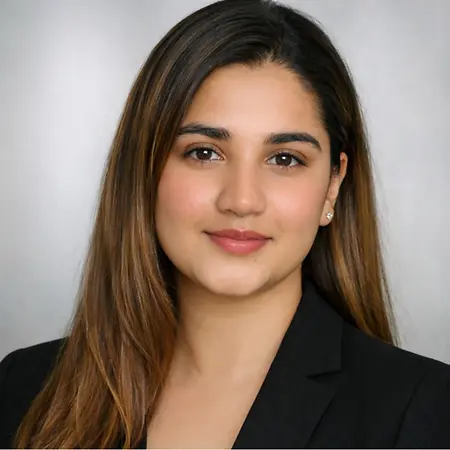
Her Story
About Urvi
I did my training in India in one of the IT companies and worked there for one and a half years. That was the time I decided I want to work something towards the IT industry, but then it became something broader because it's not only IT where people are so much stressed, it's all the industries. I got the training from IT about all the HR functions and payrolls and everything. Then I started working in a U.S. company from India. I got a business visa, and I came here, and I started working for a U.S. company before my PhD. I worked in that company for two, two and a half years. That gave me a very big expertise on how to handle clients, the client-facing roles, how American people work, and that actually inspired me to do my research into PhDs so that I can make an impact. My key responsibilities include making processes for teams, change management when there's a new leadership, preparing the employees for the change or organization for the change. I also do psychometric tests and assessments which measure the employees' strengths and weaknesses before the interview. I also do onboarding and offboarding with the exit interviews as well. Right now I'm pursuing my PhD at the Chicago School, DC campus, and every professor has been very collaborative and they've been helping me a lot finding my rhythm.
Her Interview
Ten minutes with Urvi
01What do you attribute your success to?
I would attribute my success to my parents, because coming from an Indian background, getting married at a certain age is the limit, and there are all these kind of taboos. My parents stood strong. They didn't care about the society. When I changed so many fields, I said no to my marriage, I came here, so I guess all these decisions, if they wouldn't have supported me, I don't think so I would have been able to have done it alone. Coming from an Indian background where women are expected to follow certain cultural norms, my parents gave me the freedom and support to pursue my education and career, even when it meant going against societal expectations.
02What’s the best career advice you’ve ever received?
My best career advice that I got from a mentor was, fail fast. Failing and failure is inevitable, and it's a process to your growth, so fail fast so you know that what you need to do next. That's one thing that always kept me going, that never let me give up. Even if I failed, I knew, if I fail, let's just fail fast, and just go forward and do the thing again. This advice really works with me because it helped me understand that failure is part of success, and the key is to learn quickly and move forward.
03What advice would you give to young women entering your industry?
If somebody is entering psychology or business, I would want to say is dig deeper. You don't need to feel that what I'm doing has already been done. You can always create a value, you can always contribute to the same field, you can always contribute, and if you dig deeper, you're always gonna find a better way of doing things. When I came into this field, I was so scared, because whatever topic I used to pick, it was already discussed, researched, and talked about. But now that I've been going deeper, I just feel like those are all superficial things, but real work, very less people actually do the real work. So dig deeper, just don't give in. Go forward with it.
04What are the biggest challenges or opportunities in your field right now?
There were two challenges that I felt, even in India and coming here too. One is that having such an educated background, and I'm still young, and when I talk to someone, they won't give me that much of a value what I carry for my first impression. That's one thing which has been challenging, and I'm still trying to find my rhythm, still trying to find what my first impression should look like. The second thing that was a big challenge for me is being a woman. When you actually think of not settling in and doing something which asks for you to make decisions which is gonna be hard for you emotionally, I feel like a lot of women back down because they don't have either enough support or either enough examples. So I feel like I do want to create an example in this society so that women can go forward. These are the two challenges - understanding how to carry all that I'm gaining, because I'm getting so much education or so much practices, I still don't know how to present myself. I guess that's because of where I come from, I have not been conditioned in that way, I'm not sure. But I'm still figuring out, and I feel like this is one of the challenges that a lot of women feel in their field.
05What values are most important to you in your work and personal life?
The most important values I have are professionalism, clear communication, and mutual respect. I do respect a lot of professionalism. I maintain a lot of professionalism when I'm talking to another person in a workplace, and I expect the same. I do expect clear communication. That is one thing that I'm too much onto, that no matter how much try I give, I need to make sure that my communication is very clear, and that the other person is actually able to understand. And I would feel like mutual respect is very important, no matter if it's your personal relationship or your professional relationship. To start any relationship, I feel mutual respect is the one thing that needs to be there.
Join Influential Women and start making an impact. Register now.