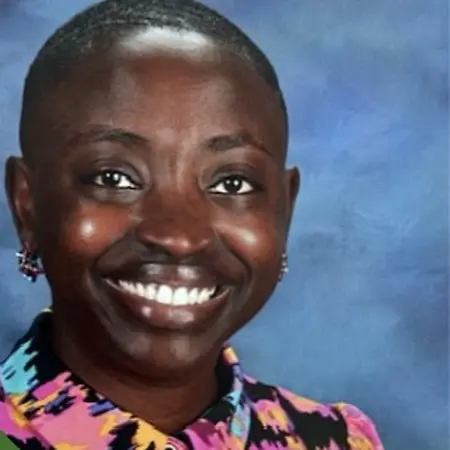
Her Story
About Whitney
I've been in special education for 10 years now, and I specialize in adaptive curriculum for students with intellectual disabilities and higher needs. My journey into this field actually started during my last semester at North Carolina A&T State University, where I was studying sociology. I had to complete an internship, and I chose an adaptive curriculum classroom, and I fell in love immediately. It was cosmic, like I just knew this is what I was created for. My passion for this work stems from my youngest brother who has autism, and seeing how we as a family were misinformed about who he was when he was growing up really drove me to help other families understand and advocate for their children. I started as a lead teacher at a high school working with students with intellectual disabilities, grades 9 through 12, and I've worked in various settings including charter schools doing resource and inclusion work. I completed my teaching license through Greensboro College in 2021 as a lateral entry teacher, and then went on to earn my master's degree in special education with a focus on adaptive curriculum in May 2024. Currently, I'm a contract teacher working with high school students, teaching math, science, daily living skills, and pre-vocational skills. My specialty is behavior modifications in students with autism, because these students aren't always verbal and can't always tell you what they need or want, so I've made it my goal to figure out how to help them communicate and reduce harmful behaviors. What makes this job worth it for me is seeing kids reach goals that people said they couldn't reach, and having former students text me years later to say hello and share how they're doing as young adults living their lives.
Her Interview
Ten minutes with Whitney
01What do you attribute your success to?
I attribute my success 100% to God, and it's not cliche at all. Throughout my career, even though I've shifted so much between different positions, I have never been without a job. God has always made a way for me to keep a job and be in good standing at those jobs. I also have to credit my support system, the people who are around me. My best friend and his family have become my family, so his mom and dad and sister are all very, very supportive of what I do. If not for Him and them, I don't know where I would be. I probably would be in a straitjacket. It's definitely God and definitely my support system that have kept me going and helped me succeed in this field.
02What’s the best career advice you’ve ever received?
The best career advice I've ever received came from my mentor, and I know it may be simple, but she told me to take seriously what my mind and body is telling me when I'm reaching burnout. She said I have to be mindful of what my mind is doing, because if I'm not mentally well, I'm not going to be well for my students. I was at a point at my school where I had been there for four and a half years, and support was far and few in between with these students, and I was debating on leaving. My mentor told me, 'I know you love your kids, but somebody's gonna love them too, you gotta love yourself more.' So the advice is really about taking care of myself and being mindful of what my mental health and physical health is doing in those times of stress and burnout.
03What advice would you give to young women entering your industry?
Be true to who you are, despite how you're seen. It's very, very important to not forget who you are and what you bring to the table, because no matter what, it's still important. A lot of women, our voices are not really seen as valuable in the workplace, and it's very hard. It's easy to fall into that stigma and be like, okay, well, I'm just gonna be quiet. But you gotta remember that your voice counts, too. It matters, too. And what you have to bring to the table, what you have to say, it is important. Say it with respect, of course, but say it. Don't let anyone else set your value for you, because they may not even completely understand the depth of who you are and what you bring to the table.
04What are the biggest challenges or opportunities in your field right now?
The biggest challenges in my field right now are that the field is changing in a way that I'm not really fond of. They're taking away separate setting schools, which are actually beneficial for kids who have more severe needs, and they're trying to blend them in spaces they can't grow. If a kid has sensory issues and you put them in a space with 12 kids, that's going to be an issue. They're taking away those more exclusive spaces for those kids and putting them in spaces they don't belong, which is causing us to deal with more aggression. Another major challenge is uneducated administrators regarding what we do for a living. Our administrators don't understand that we don't want to be hit, and we would like for them to come and support us and send students home too when there's aggression. They can't just say, 'well, oh, they have autism, we're not going to get suspended.' Our safety is at risk, and they have to take that very seriously.
05What values are most important to you in your work and personal life?
At work, the most important values to me are professionalism, integrity, and honesty. I tell my students my saying, and they can tell you what I tell them too: the truth keeps you safe, doing the right thing keeps you safe, being a good person keeps you safe, and despite how you're treated, still be a good person. I try to show up and be honest at all times. Even when I make a mistake with a kid or a parent, I stand up and say, hey, I was wrong, I apologize, and we can do this differently next time. It's about standing in my truth and standing in integrity. In my personal life, my relationship with God and my spirituality is a big part of my life. In that, it's being authentic, being honest, and being true to not only myself, but the people who are around me. I really believe kindness is important, being kind to people even when they're not kind to themselves, still showing kindness to everyone, and loving on people the way God loves on us. That's very important to me.
Join Influential Women and start making an impact. Register now.