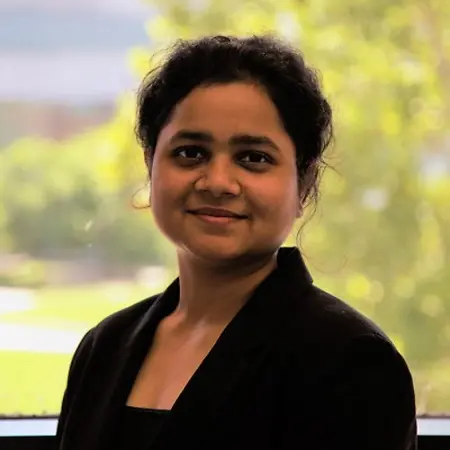
Her Story
About Akanksha
I started working in industry in July of this year at Amphenol, a telecommunications systems company that's part of the larger Amphenol Limited corporation. As an Advanced Materials Engineer, I qualify polymer-based materials that go inside electrical connectors - components that are essential for high-speed data transmission. Most people don't realize that while connectors are made of metals, there's a very small but critical polymer component inside that makes high-speed data transmission possible. I develop property-performance relationships for these materials and work with people developing next-generation materials, helping them understand the smaller nuances of how materials work and how they can be used to create high-speed connectors. We work with major clients like NVIDIA, Amazon, and Google around the globe, and I help troubleshoot field failures and problems that arise. My journey into this field began in my undergraduate studies around 2016 when I discovered electronic textiles and smart textiles - a field that combines electronic or electrical features into textiles to create sensors, actuators, or even entire wearable computers. I worked on this with my supervisor during my undergrad, and the polymer aspect of textiles naturally led me to electrical polymers, which is a subset of the e-textiles field. Before joining Amphenol, I completed my PhD at NC State University under Professor Tashar Ghosh, where I gained tremendous knowledge about polymers and electronics combined together. I also did an internship with Procter & Gamble where I created a highly optimized textile-based product in just three months. Throughout my PhD, I mentored newer students and undergrads, explaining electronics concepts in terms that polymer engineers could understand, and I led lab sessions for 30 to 40 students multiple times a week.
Her Interview
Ten minutes with Akanksha
01What advice would you give to young women entering your industry?
As a polymers engineer, you have the capacity to look at a high-speed connector, for example, in a very different light than what an electrical engineer can do. I would say to keep a broad mind and learn about electronics, and then combine what you know about electronics or electrical features with your understanding in polymers to really become a very holistic engineer in this field. I think never stop learning and simplify concepts - those are the other two things I'd say. It's interesting because your unique perspective as a polymer engineer brings value that others in the field can't provide.
02What values are most important to you in your work and personal life?
My parents were deeply involved in social services, and that exposure helped me look beyond the lab and understand the actual problems people face in their everyday lives. When I look for solutions, I try to consider not just lab feasibility, but whether it actually helps the human beings involved. I'd rather make a small innovation that affects a lot of people versus make a big innovation that affects fewer people. Through my work in entrepreneurship during undergrad, we developed technical solutions for issues like landfill overburdening and eco-friendly waste disposal. I spoke with stakeholders at every level - from people who hand-pick waste to those managing incineration plants and landfills. When you talk to people at so many different levels who are all part of the same problem, you start to look at things in a much deeper sense than what a technical person would normally know. This really drives my research on a day-to-day basis - I like to make something which really touches people and is feasible outside the lab. This applies not just to my technical work, but also to my involvement with Graduate Women in Science, where I worked to recognize exceptional women and their contributions. You learn that there are so many people who have done so many things but are never recognized, and at the same time, there are people who do so much and are so humble - it really keeps you grounded.
Join Influential Women and start making an impact. Register now.