Her Story
About Amelia
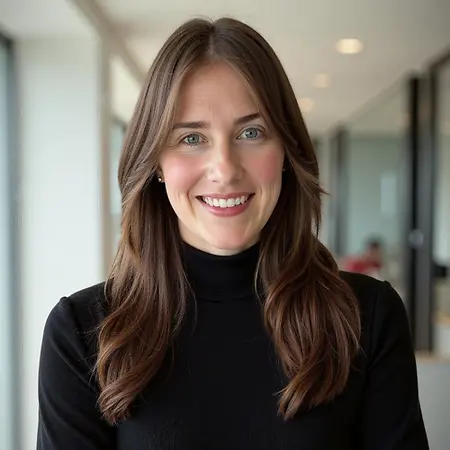
Amelia Giordano is the Deputy Chief of Staff for External Affairs at Golden Gate University, where she helps lead cross-functional efforts during a period of significant transformation. With nearly two decades of experience in higher education, she brings expertise in organizational planning, leadership communications, operational coordination, and enterprise-wide project management.
Her path into higher education was anything but traditional. A high school dropout who faced significant obstacles early in life, Amelia worked four jobs while attending night school to earn her diploma. She went on to attend community college before transferring to Northeastern University, where she completed her bachelor’s degree and later earned her master’s while continuing to work full time. Her educational journey transformed not only her career opportunities, but also her confidence and understanding of what was possible for her life.
Amelia spent approximately 15 years at Northeastern University, holding 10 progressively complex roles across strategy, communications, advancement, administration, and executive operations. Her work included managing organizational functions, overseeing executive-level projects, supporting advancement and prospect relations efforts, and partnering across the institution to advance strategic priorities. Her background in psychology, human resources, and leadership shaped a people-centered approach to organizational planning and institutional operations.
A PMP-certified leader, Amelia has extensive experience guiding large-scale organizational efforts, including enterprise system implementations involving Workday, ServiceNow, and JAGGAER. She is known for developing change management approaches, engagement plans, and communication frameworks that support adoption, collaboration, and long-term alignment.
At Golden Gate University, Amelia’s work focuses on aligning institutional messaging, stakeholder engagement, and campaign planning in support of the institution’s broader goals and evolving priorities. She works closely with senior leadership to coordinate high-impact efforts and strengthen institutional visibility during a dynamic period for higher education. Drawn to GGU’s long-standing commitment to working adults and its willingness to evolve alongside changing workforce and student needs, Amelia is particularly interested in how higher education can adapt to emerging technologies and the future of work.
Amelia’s commitment to higher education is deeply personal. Having experienced firsthand how education can transform the trajectory of a person’s life, she remains passionate about expanding opportunity for adult learners, students from challenged socioeconomic backgrounds, and individuals seeking to reshape their futures.
Her Interview
Ten minutes with Amelia
01What do you attribute your success to?
I attribute my success to maintaining a growth mindset and staying open to learning, especially from the people around me. Higher education gave me the opportunity to work alongside individuals who are constantly pushing themselves, their organizations, and their ideas forward, and that environment shaped the way I approach both leadership and personal growth.
I was also fortunate to have leaders who saw potential in me before I fully saw it in myself. They gave me opportunities to grow into new roles and responsibilities, often shaping positions around my strengths as much as the organization's needs. That experience taught me how impactful it can be when leaders invest in people thoughtfully and intentionally.
Much of my success also comes back to my mother, who never gave up on me during some very difficult periods in my life. She constantly reminded me that I was capable of more and that my future did not have to be defined by my circumstances. Combined with the opportunities education provided, that support completely changed the trajectory of my life. It gave me confidence, stability, and a sense of direction I did not always have.
02What’s the best career advice you’ve ever received?
One of the best pieces of career advice I’ve ever received was to stay open to opportunities that may not perfectly align with the path you originally envisioned for yourself. Some of the most meaningful growth in my career came from stepping into roles I had never planned for, often because someone else saw potential in me before I fully saw it in myself.
I also had a professor during the capstone of my undergraduate psychology program, William Sharp, who introduced an idea that stayed with me long after graduation. He spoke about the belief that much dysfunction in life comes from people’s attempts to avoid suffering, rather than accepting that hardship is an inevitable part of the human experience. That perspective planted a seed for me. Over time, especially in my late twenties, it evolved into a much deeper understanding that growth often requires discomfort, accountability, and a willingness to confront difficult realities instead of avoiding them.
That mindset fundamentally changed the way I approached my life and career. It helped me develop a stronger internal locus of control and recognize that while we cannot control every circumstance, we are not passive participants in our own lives. We have agency in how we respond, how we grow, and how we move forward.
Professionally, that translated into being willing to take risks, embrace change, and continue evolving. My career has spanned communications, operations, strategy, leadership initiatives, and organizational change, much of which developed because I stayed curious and open to opportunities outside of my comfort zone.
More than anything, I’ve learned that careers and personal growth are rarely linear. The most important thing is to remain adaptable, grounded in your values, and willing to keep learning, even during periods of uncertainty or challenge.
03What advice would you give to young women entering your industry?
I would encourage young women entering higher education to stay curious, open-minded, and committed to continuous learning. Higher education is an industry built around growth, not just for students, but also for the people who work within it. The most successful people I’ve worked with are those who are willing to evolve, challenge themselves, and contribute to something larger than themselves.
I also think a lot about the kind of leaders we choose to become based on our own experiences. I have encountered environments where struggle was sometimes treated as a rite of passage, where people believed others should endure the same hardships simply because they had to. I never want to lead that way. I believe leadership should create opportunities, support people through challenges, and help others grow, rather than making success harder to earn out of principle.
For me, leadership means being the kind of example I wish I had seen more often: someone who uplifts others, values empathy, and understands that people do their best work when they feel supported and respected. We do not become stronger by making others struggle unnecessarily. We become stronger by creating environments where people can succeed together.
04What are the biggest challenges or opportunities in your field right now?
One of the biggest challenges and opportunities in higher education right now is navigating rapid technological change and understanding what it means for the future of work. I’m especially interested in how organizations adapt to these shifts while still keeping people at the center of decision-making.
As technology continues to evolve, I think there is growing value in people who can think critically, connect ideas across disciplines, and understand how decisions affect organizations as a whole. While there will always be fields that require highly specialized expertise, many organizations also need leaders and professionals who can step back, see the broader picture, evaluate competing priorities, and guide thoughtful change.
I also think we are at an important moment culturally, where critical thinking, adaptability, and human-centered leadership matter more than ever. Technology can increase efficiency and create new possibilities, but institutions still depend on people who can ask thoughtful questions, navigate complexity, communicate effectively, and understand the human impact of change.
For me, that is the most important part of this conversation: where people fit into all of it. No matter how much technology evolves, I believe the organizations that succeed will be the ones that continue investing in people, helping them adapt, and recognizing the value that human insight and empathy bring to transformation efforts.
05What values are most important to you in your work and personal life?
The value that matters most to me is compassion for people and a genuine investment in their growth. I’ve always been fascinated by how people think, adapt, collaborate, and navigate change, and that curiosity has shaped both the way I work and the way I lead.
I also place a high value on humility and continuous learning. I do not believe anyone ever fully arrives professionally or personally. The most effective leaders are the ones who remain open to new ideas, willing to evolve, and able to acknowledge when they do not have all the answers. That mindset has been especially important in higher education and in organizational leadership, where change is constant.
Integrity is equally important to me. I believe leadership should create opportunities rather than unnecessary obstacles. I never want to approach leadership from the perspective that people should struggle simply because struggle has traditionally been seen as part of professional growth. I think people thrive when they feel respected, supported, and trusted, and I try to lead with that in mind.
Finally, I value purpose-driven work. Education changed the course of my life in profound ways, and I carry that perspective with me every day. Being able to contribute to institutions that help people build confidence, stability, and new possibilities for themselves is work that feels deeply meaningful to me.
Join Influential Women and start making an impact. Register now.