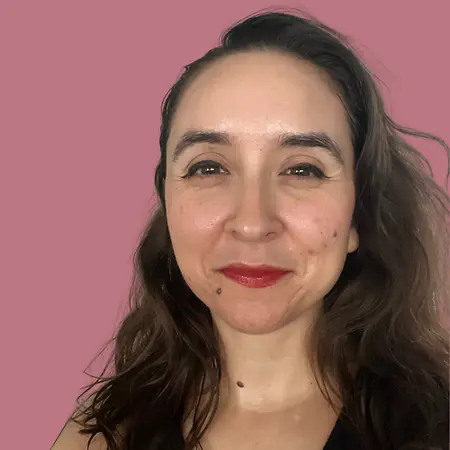
Her Story
About Amparo
I'm a first-generation professional, and throughout my career I've had to stumble along and learn as I went. I had my day job, but also either outside of work or even within work, I was always dedicated to supporting women and people of color through every role, or through mentorship roles outside of work. As someone who has undergone various forms of harm myself, there were parts of my journey where I was in survival mode, doing whatever I could. But throughout that entire experience, I was always dedicated to supporting women in any way that I could, from establishing alumni groups, mentorship, or coaching programs. My specialty is being able to see the underlying layers of people - to see what makes them beautiful, what makes them strong, what gaps they may not even be aware of. I can see when people are being self-deceptive, or maybe not necessarily sharing the truth outwardly. I'm also really good at developing ideas based on a larger vision, so I have both the operational and the vision side. I'm able to turn big visions into reality, which comes in very handy with building out programs and organizations. I'm able to hold on to the idea of what someone or something could become, and strongly encourage and push and guide someone or something in that general direction. I'm able to cross-pollinate really well because I have so much cross-industry experience - I've worked in all sorts of different departments and different roles. This helps me to see the larger picture, to translate ideas to different people and different fields, and to create ideas that are very unique because they include information from my background as a woman of color, as a first-generation alumni, as a first-generation professional, my upbringing within impoverished immigrant communities, my background in data analysis, marketing, and so much more. The ideas that I create tend to be a mixture of all of those things, and they tend to be very unique and strong as a result. The combination of that with my ability to see the deeper layers of the human being helps me anticipate 5 to 10 steps ahead of how something could turn out, and using that to my advantage in leading my team has been very helpful.
Her Interview
Ten minutes with Amparo
01What do you attribute your success to?
I attribute my success to a deep sense of resiliency, a deep connection to nature, to my ancestry, to parts of my identity that couldn't be taken from me. The experience of abuse includes the erasing of anything that makes you strong, anything that makes you independent, anything that would serve as anything that would confront the type of control that the abuser wants of you, which includes the parts of your identity that make you strong. But there were parts of my identity that weren't touched, they couldn't be touched, and those parts of my identity saved me in the end. It's the strong, the deeper, deeper layers of my own identity that served as a moving force, as a motivational force, and that reminded me of who I was and who I could be when everything felt lost and was lost. I've navigated quite a lot of my journey on my own, but there have been a few people that have either literally saved my life or have been a huge source of support. While most of my journey was alone, I couldn't have made it here without those people. It speaks to the power of just having one person in your corner. I couldn't have made it here without that. The resources that I've been afforded as well - I'm very fortunate to have gone to organizations like Stanford, to have gone to organizations like George Washington. The first time that I went to Stanford was the first time that I saw so much joy around me. It was really striking. Those experiences, and the domino effect of those experiences, and the resources, and the network, and the education that I continue to have access to made a huge difference. In reconnecting back to those networks, reconnecting back to those communities, there was a huge difference in what my life would have turned out to be at this point. I have to credit organizations like Girls Inc hugely with regards to my journey, because they were the first organization that gave me a taste of seeing myself as a possible leader, of seeing myself as someone with ideas that were worthwhile to share and to consider. They stayed in my life throughout this time, and it was organizations like them, communities and people like them that helped me to navigate this incredibly, incredibly nightmarish experience and to come out on the other side with the ability to turn it into a solution for others.
02What’s the best career advice you’ve ever received?
Something finally clicked at a certain point early on in my professional career that sort of put together various conversations I'd had with various people into a new perspective. It's the idea that hard work is not enough. There are a lot of things that we're taught, according to whatever generation we're a part of, and the idea of just work hard and you can make all of your dreams happen was a constant message that I heard growing up. I worked really hard, in part because of who I am, but also in part because that's what I was told, that that's all you need. Early on in my career, once I made it out into the real world after college, I realized within a few years, oh, that was a lie. And actually, as I think back on my community, my community was full of hard workers, but they were poor. So I realized that there were certain things that I had been taught to believe about the world, about the world of work, about professionalism, that just weren't true. It caused me to reconsider my approach to work and the assumptions that I was taking into work, and to no longer just focus on output, no longer just focus on the hard work component, but to start to broaden my understanding of me within that world of what it is that I wanted, what it is that made sense to me, and to also take a different look at the results that are produced out in the world. How much of the results are actually because of connections? How much of them are actually because of resources that someone has access to? How much of it is because someone hasn't endured severe abuse in the recent 5 years of their life? There are all these other factors - how many people are not dealing with medical issues that also affect their ability to be present in work, or how many people are dealing with neurodivergencies and they're existing within environments that are just not made for them and don't cater to them, don't support them. There are all sorts of other factors that have to be taken into consideration, because unless they're taken into consideration, solutions won't actually be well done, well-crafted, and will continue producing sort of half-efficient or inefficient, lacking in support environments where solutions just stay on the table, they're not created. It's important to take a look at the entire picture of how things come to be.
03What advice would you give to young women entering your industry?
A really good starting point is self-knowledge and self-awareness, and specifically within that, what are those things that you've struggled with? What are those things that have challenged you? What solutions do you wish existed for you then or now? Whatever that is, is a clue. It's just a clue, it's not necessarily an entire picture, but it's a clue about what one could pursue professionally or as an entrepreneur. Knowing what one's challenges are, knowing what one's needs are - please do not proceed forward without knowing what your needs are, because the world is not designed to be able to naturally and easily support you in that, unless you're very lucky and you stumble across a very healthy work environment. Start with understanding yourself first, the challenges, the things that you've gone through, your needs, the solutions that you wish existed for yourself in the past or in the present, and either consider turning that into a solution for others, or use it at least as a baseline for understanding yourself better. Having that heightened level of self-awareness, of self-reflection, helps you to then navigate spaces that, again, aren't designed for you. For the most part, companies are not designed for women. They're not - most companies are not led by women. Even companies that are led by women, they're often modeled after companies that were made by men for men. And so, knowing ourselves and knowing our own needs is foundational to even enter into those environments without losing ourselves, especially as young women.
04What are the biggest challenges or opportunities in your field right now?
I would say that one of the ones that I think a lot of people would point to is funding. The world of funding is notoriously difficult for nonprofits to navigate, especially early nonprofits. But truthfully, I haven't put a whole lot of effort into it because I've been focused more on the building part of the process, so that's just what I've heard. I also am not the most comfortable asking for money as a woman of color who grew up in the hood, so that's been something that's been a through line throughout my entire professional experience, but I consider those temporary problems - it's just a skills gap that I'll close by going. There are challenges, to be quite honest, but because of everything that I've lived, everything that I'm experiencing now as a challenge is so minor in comparison to everything else. When you've lived through very severe PTSD and CPTSD, and you have the experience of no longer feeling human, everything else feels minor. Yes, there are challenges with time. My weeks are very full. I have to be very dedicated to figuring out what my schedule is ahead of time, I have to be very structured, very organized, and yes, sometimes I experience burnout, but those pale, they're puny in comparison to what I've lived. So that's my current reality, at least for now.
05What values are most important to you in your work and personal life?
I'm very service-oriented, so service-oriented and mission-driven, authenticity, care, compassion, connection - those are all very important values for me. I'm a very human-first person. As important as it is to present as a respective professional, to me it's even more important to create spaces where humans can feel human and be human, and connect as humans, and to relax, have their nervous systems relax, that it's okay for them to stumble on their words, it's okay for them to show their kids, it's okay for them to share ideas outside of what's immediately within their purview. It's okay for them to show up as whole, being whole people. And those values that I listed off, they help the creation of that. Being very service-oriented, focusing on win-win-win. Our world is very driven towards win-lose. I'm very win-win focused, and beyond that, win-win-win. And I think that anything less than that is just lazy. I think it takes a very creative person to think about win-win and win-win-win solutions, and I think that's what's needed, and I think women are very well equipped for that, if they allow themselves to envision that. Care, compassion, camaraderie, connection, authenticity, care - all of these are really important values that I consider to be part of my core.
Join Influential Women and start making an impact. Register now.