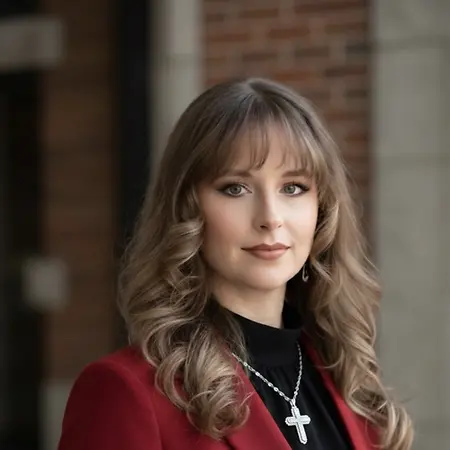
Her Story
About Ashley
From an early age, I always wanted to go into education because I am drawn to service. My mother was a stay-at-home parent and homeroom mom who always encouraged me to go into teaching. I started my career in August 2008 as a Pre-AP and regular English teacher at Northside High School in Fort Smith, Arkansas. I have always been driven by impact and by strengthening people through service and stewardship.
I progressed to teaching Advanced Placement Language and Composition and became the AP English Lead Teacher for the Arkansas Advanced Initiative for Math and Science at Northside, which provided me with the experience of working with compliance, accreditation, assessment, AP instruction, and vertical teaming from the high school down to junior high feeder schools and multiple elementary schools, and working across the state as a liaison.
In August 2012, I transitioned to an instructional facilitator role at Darby Junior High School for six and a half years, where I was featured in Diane Sweeney’s collaboration with AR Ideas for being a successful instructional coach. Creating impact is innate to me. It is not necessarily about the title, the role, or the job; it is about how I can help people and what stewardship I can provide.
I then moved to the Arkansas College of Osteopathic Medicine, starting as a board preparation specialist before becoming the Director of Data Analytics and Institutional Research and an Assistant Professor. I developed a strength for structuring programs and helping them mature through compliance reporting, assessment, and accreditation.
Most recently, I accepted the role of Director of Graduate Program Assessment and Evaluation at Franklin Pierce University. I still serve one university, but the geographic scope of my work has expanded significantly. I now support graduate programs across multiple states, including New Hampshire, Texas, and Arizona. While the reach has grown, the purpose has not changed—it is still about service, stewardship, and sustained impact.
Her Interview
Ten minutes with Ashley
01What do you attribute your success to?
I attribute my success to resilience and faith in God, especially after losing both of my parents in my twenties. My father was diagnosed with Alzheimer’s while I was in college, and my mother passed unexpectedly while I was completing my graduate work. Much of my academic journey unfolded alongside caregiving and loss. I remember studying in hospital rooms and learning, very early, how to carry responsibility before I felt ready.
Those seasons deepened my faith and clarified my purpose. When you have walked through that level of loss, professional setbacks no longer feel defining. They feel manageable. I learned to remain steady in my character, lead with dignity, and let my work speak for itself.
I had to transition from being the child to becoming the caregiver more quickly than expected, and that resilience, along with my husband’s steady support, reshaped how I lead. Success, to me, is not about circumstance. It is about showing up with clarity, grace, and discipline regardless of the season.
02What’s the best career advice you’ve ever received?
During my teaching internship, I was told to treat everyone with respect, regardless of title. That advice has guided every role I have held.
Institutions function because of collective effort—from frontline staff to executive leadership. Respect builds trust, and trust sustains systems. Without trust, no strategy can succeed. Regardless of degree level or role, every individual brings expertise to the table. Thriving organizations are built on mutual respect and shared accountability.
A credential or title does not grant permission to diminish others. Strong leaders understand that dignity, professionalism, and collaboration create momentum and meaningful accomplishment. Respect is not optional; it is foundational to excellence.
03What advice would you give to young women entering your industry?
Over time, I have learned that women in education can sometimes face environments where scrutiny replaces support or where collaboration gives way to competition. It does not have to be that way. I am deeply collaborative, and those experiences reinforced something important: steady character, dignified leadership, and consistent work outlast opposition. Kindness is not weakness. It is disciplined strength.
When competition becomes destructive, everyone loses, including the students and communities we serve. Strength does not require aggression. Advocacy does not require diminishing others. When one woman advances with integrity, it expands what is possible for others.
My encouragement to young women entering the field is to remain grounded in humility and confidence simultaneously. Character and competence must move together. Supporting other women openly and sincerely strengthens the profession. Opposition should not be internalized; it can refine resolve and clarify purpose. Sustained excellence rooted in integrity is the most powerful statement any leader can make.
Institutions are stronger when women choose collaboration over competition.
04What are the biggest challenges or opportunities in your field right now?
Higher education is evolving in ways that invite disciplined, systems-oriented leadership. Institutions are being asked to operate with greater clarity, measurable impact, and sustainable governance. That shift creates space for leaders who understand structure, accountability, and long-term strategy.
Women are increasingly stepping into structural roles and shaping the systems that protect institutional integrity. When rigor and relational intelligence intersect, institutions become stronger, more transparent, and more resilient.
At the same time, one of the ongoing challenges within education is maintaining a culture of mutual respect and collaboration. In some environments, comparison can overshadow cooperation, and subtle forms of internal competition can erode trust. If we choose to see one another’s strengths as assets rather than threats, institutions benefit. When women grow together, institutions grow stronger.
There is also an important conversation around professional rigor. Higher education is complex, compliance-driven, and administratively demanding. It requires disciplined leadership, thoughtful governance, and strategic planning. Reinforcing the professional standards of education matters deeply because teaching and institutional leadership are not fallback roles—they are critical to societal advancement.
As a first-generation college graduate, I believe education remains one of the most powerful equalizers in society. That is why strengthening compliance structures, raising standards, and approaching strategy with integrity are so important to me. When we treat education as both a profession and a stewardship responsibility, we protect its long-term impact.
05What values are most important to you in your work and personal life?
Faith, integrity, resilience, and stewardship are the things that guide my leadership and my life.
My faith is what keeps me grounded. It reminds me that being a leader is not about getting recognized; it is about being responsible. Integrity is something that cannot be compromised. In both professional and community settings, clarity and transparency protect institutions and ensure we do what is right.
My personal journey and my leadership style have been shaped by resilience. In situations, whether it is in education, working with nonprofits, or leading a community, I have learned that being strong does not come from being in charge or trying to intimidate people. Strength comes from being clear, being competent, and having character. I have found that being consistent and having a plan is what works best. There are moments in any leadership journey where pressure, politics, or power dynamics test you. When you lead with discipline and integrity, fear-based leadership has no foundation.
I really believe in the power of having a plan. Whether I am helping with accreditation, serving on a nonprofit board, or collaborating with a community, I like to build systems that create stability and trust. Evaluating our progress and holding ourselves accountable to what we promised is not just an obligation; it is how we safeguard quality and integrity. It makes sure that we keep the promises we make to students, families, and communities.
For me, it comes down to doing more than the minimum, choosing clarity over confusion, leading with discipline, and treating people with respect.
My goal, whether I am working with an organization in my community or just giving advice, is to help make organizations stronger. I want to ensure that what is being pursued is aligned with how success is measured and that strategy reflects core values. I want to be known as someone who creates environments where people can do their best work without fear, where expectations are clear, and where meaningful results follow.
Join Influential Women and start making an impact. Register now.