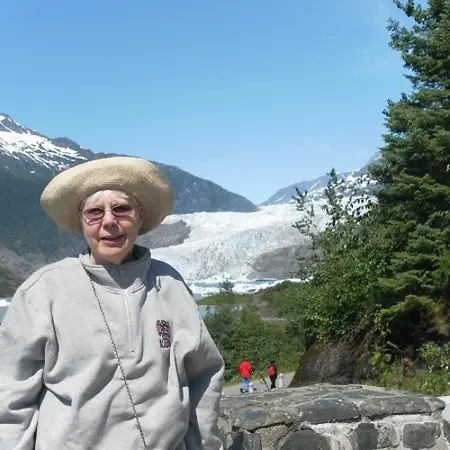
Her Story
About Deborah
I graduated with my engineering degree in 1988 and went to work at NASA, where I spent 7 years as an instructor to the astronauts on instrumentation and communications. I helped move the system from the Honeywell mainframe to the Unix system and developed the system to train the shuttle mating with the mirror for communications - not the aeronautic stuff, the communication stuff, how they talk to each other. Before that, I was coordinating all of the communications for intelligence communications for Europe in the Army, and that's when I discovered I could do satellite shots in my head. People would look at me like 'You're doing what? How do you...' and I'd say 'well, it's simple, it's simple trick, you know?' One of the things I'm extremely proud of is my work at Ameren, where I sat down with individuals and wrote task-based criteria for technical positions - things like 'yes, once in a while you do have to lift 50 pounds, or you have to climb up 30 feet in the air.' Those are criteria that are more relevant than are you a man or a woman. That helped make hiring more equitable for women. I also worked updating the instrumentation and electrical maintenance tasks at Kennecott in Salt Lake. I was lead engineer at NASA for 11 months before they even gave me the title, and it wasn't even a pay increase, just a title change. Now that I'm retired, I volunteer teach music a couple times a week, play in the local symphony, coordinate the free concerts at the public library, and I have a flute choir - and I don't even play flute, I play recorder, but they let me play with them.
Her Interview
Ten minutes with Deborah
01What do you attribute your success to?
I attribute my success to my father, who never treated me like girls couldn't do things. He was a West Point graduate, and when I was in high school, on Saturday mornings while he was fixing breakfast, we would discuss mathematics. He never had this thing that women can't do - it was never 'girls can't do that.' It was 'girls can, and you get out and do it.' When I was about 7 or 8 at Kiesler Air Force Base, he sent me to talk to an Air Force major woman, and we just kind of connected. I think it had a major influence on me, and I didn't even know it. She talked about her foreign travel and the furniture she'd picked up in different countries, and that got my interest. My dad never treated us like 'you're girls and you have to do in-the-door work.' When he needed an 18-foot trench dug through the adobe in Tucson for my mother's rose garden, he said 'you, get out there and do it,' and I went out there and did it. I also learned from my professors that there's a lot of geniuses out here walking around, but if you can't explain it in everyday terms to the man on the street, you can't get funding. That ability to communicate clearly and simply was crucial to my success.
02What’s the best career advice you’ve ever received?
The best career advice I ever received was from my professors, who told me that there's a lot of geniuses out here walking around, but if you can't explain it in everyday terms to the man on the street, you can't get funding. That taught me to communicate complex engineering concepts in simple, casual terms that anybody would understand. I would explain things to other engineers by saying things like 'that's like when you fry an egg, it fries on the bottom, so now you flip it over to get at the top.' That skill of making requirements clear and simple became one of my greatest strengths. I remember one time at Johnson Space Center, they said my change request was going to cost something under $300 and 37 cents or something like that, and when the president of the board asked how they knew it would only cost that much, the guy said 'Because she made the requirement so clear and simple, we've already got it, we're good, we're getting approved after the fact.'
03What advice would you give to young women entering your industry?
I would say get strong in math and build your skills. I even go out and talk to elementary school kids on Engineering Month in February about getting strong in math and building your skills. One of the things I think is that women have a tendency to underestimate their skills, and men overestimate their skills, generically. So I would say, when you look at a job position, look at it and realize this is their wish list - they're not going to get anybody that can walk on the moon doing handstands. So which things can you do? Highlight those. And which things are you willing to do, and you think you can do if you had a couple of weeks training? Highlight what you're able to do and also what you're able to learn. You still have to stand up and say 'hey, this is what's right,' but sadly, you have to do it graciously. Men go in there and they stomp and jump and scream. Women have to do it graciously, otherwise it's 'oh, she's just in a bad mood.' So you still have to be gracious, you have to be firm, but you have to be firm and gracious at the same time. You have to be firm, you have to be rational, and you have to be calm.
04What are the biggest challenges or opportunities in your field right now?
I don't think the challenges have changed significantly from when I was working. The woman still has to go in and be firm, and she has to be rational, and she has to be calm. I remember one of my friends coming out and saying they asked her how many babies she was planning on having - and that's not legal, but it's how you address that. Women still face inequity in getting titles and recognition. I was lead engineer at NASA for 11 months before they got me the title, and it wasn't even a pay increase, just a title change. When I got fed up and they put in a Black man who was junior to me, they got his title in less than 3 months. They said 'well, we have more women working at NASA than we have black men.' You still have to stand up and say 'hey, this is what's right,' but you have to do it graciously. Men go in there and stomp and jump and scream - women are not supposed to yell, that's unprofessional. So you still have to be gracious, but you have to be firm. It's not changed.
05What values are most important to you in your work and personal life?
One of my most important values is understanding that when you think about getting from point A to point B, there's an infinite amount of routes to get there. I always take the straight route, mine is the shortest, but that isn't always the best route, just like in traffic - there's a wreck up ahead, you better take exit 120 to avoid the wreck. There are always more than one cause for any significant event, and what's important is not to be in a hurry to place blame, but it's better to be there to find the solution. I also value honesty about imperfection. I tell the kids I teach music to, 'they think I'm perfect,' and they go 'oh, no, Mrs. Stevenson, you're not perfect, you make mistakes,' and I say 'that's right.' I ask them, 'do you think your computer is perfect?' when it's depending on and relying on somebody like me. I'm also passionate about elevating women and making them understand that they can do and achieve. When I look at Afghanistan, any country that denies 50% of its brainpower, use of brainpower, it's condemning itself to poverty. That's where I care the most - making sure other women know that they can do it.
Join Influential Women and start making an impact. Register now.