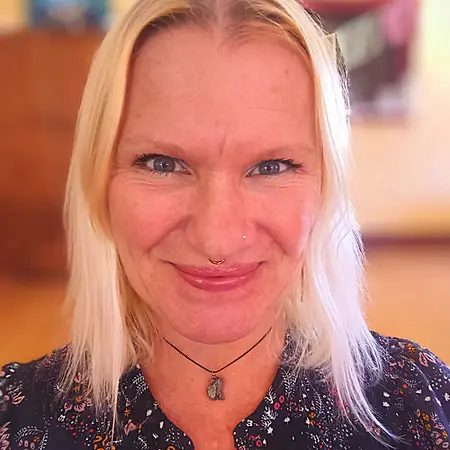
Her Story
About Jemima
Jemima Godsall is a Breathwork & Embodied Awakening Movement, and Pilates Facilitator devoted to guiding influential women back into the wisdom and power of their bodies.
Through consciously connected breathwork, intuitive embodied movement, and over two decades of applied movement expertise, she helps women regulate their nervous systems, release stored emotional tension and reconnect to their authentic voice. Her work bridges somatic healing with strength and structural integrity, supporting high-capacity women to move beyond burnout and lead from grounded presence.
Rooted in lived experience and deep training, Jemima creates transformative spaces where breath becomes medicine, movement becomes awakening, and the body becomes home.
Her Interview
Ten minutes with Jemima
01What do you attribute your success to?
When people ask me what I attribute my success to, they often expect something strategic.
A business plan.
A marketing funnel.
A breakthrough moment.
But the truth is quieter than that.
My success comes down to one thing: I never stopped coming back to my body.
Success, for me, was never about status or scale. It was about survival at first. Then healing. Then devotion. Breath by breath. Movement by movement.
I have lived through trauma. Addiction. Deep grief. Reinvention. And at every stage, what saved me, and continues to guide me, is the willingness to sit with myself and breathe.
Not bypass.
Not numb.
Not perform.
Breathe.
The breath taught me regulation before I knew what regulation meant. Movement gave me expression before I had language for my pain. Pilates gave me structure when my life felt chaotic. Embodied awakening gave me permission to feel powerful without being hard.
My success is not built on perfection.
It is built on:
• Consistency over intensity
• Integrity over image
• Depth over speed
• Community over competition
• Listening to my nervous system instead of pushing past it
I live off-grid in the desert now. That wasn’t accidental. The desert taught me spaciousness. It taught me that nothing blooms without patience. It taught me that stillness is not stagnation, it’s incubation.
I attribute my success to staying teachable.
To continuing my education.
To refining my craft.
To honoring the fact that I am both facilitator and forever student.
And most of all, I attribute it to centering in love.
Love for the four-year-old inside me who deserved safety.
Love for the woman I am becoming.
Love for the women I serve.
Success, to me, is this:
A regulated nervous system.
A body I trust.
Work that aligns.
Clients who feel safe.
A life that feels honest.
That’s it.
Everything else is a byproduct.
02What’s the best career advice you’ve ever received?
The best career advice I ever received wasn’t about scaling.
It wasn’t about branding.
It wasn’t about networking.
It wasn’t even about confidence.
It was this:
“Don’t build your career from your wounds. Build it from your healing.”
At the time, I didn’t fully understand it.
I had survived trauma. Addiction. Loss. Reinvention. My instinct was to prove something. To push. To succeed in a way that made the past irrelevant.
But that advice stopped me.
It made me pause and ask:
Am I serving from scarcity or from sufficiency?
Am I teaching what I’ve integrated, or what I’m still bleeding through?
That one sentence reshaped everything.
Instead of rushing to monetize my pain, I committed to embodying my work first. I let breathwork regulate me before I guided others. I let Pilates strengthen me before I positioned myself as an authority. I let embodied awakening movement soften and empower me before I invited women into it.
I built depth before visibility.
And that changed the quality of everything.
Now, when influential women come to me, leaders, creatives, entrepreneurs, they aren’t just looking for tools. They’re looking for someone who is regulated, steady, and grounded in their own body.
The best advice I ever received taught me this:
Your nervous system is your real résumé.
Credentials matter. Experience matters.
But embodiment is what people feel.
And people always trust what they feel.
03What advice would you give to young women entering your industry?
If you are entering the world of breathwork, embodied movement, Pilates, or healing work, I want to tell you something gently, and honestly.
This field will ask you to know yourself.
Not just intellectually.
Not just spiritually.
But somatically.
My first piece of advice is this:
Do your own work. And keep doing it.
Do not rush to teach what you have not fully integrated.
Your nervous system is the container for every room you lead. If you are dysregulated, your clients will feel it, even if they cannot name it.
Second:
Build skill, not just inspiration.
Breathwork is powerful. Embodied awakening movement is profound. Pilates requires precision. Study anatomy. Study trauma-informed care. Study the nervous system. Get mentored. Be supervised. Refine your craft.
This work deserves rigor.
Third:
Don’t confuse visibility with impact.
Social media can make it look like everyone is scaling quickly. But real transformation is slow. Sustainable success is built on integrity, not virality.
Depth over speed.
Fourth:
Protect your energy.
You cannot pour from an empty nervous system.
Have boundaries. Rest. Move your own body. Breathe without performing. Have spaces where you are not the facilitator.
And finally:
Stay human.
You are not meant to be the enlightened healer on a pedestal. You are a woman in a body, learning as you go. Clients don’t need perfection, they need presence.
If I could speak to my younger self entering this work, I would say:
Slow down.
Integrate.
Strengthen your foundation.
Let your embodiment speak louder than your branding.
This field doesn’t need more performance.
It needs more regulated, grounded, skillful women who are willing to do the work inside themselves first.
Be one of them.
04What are the biggest challenges or opportunities in your field right now?
1. Keeping Depth Over Trend
Breathwork, embodiment, and somatic movement are often simplified into trends, quick fixes, or Instagram-ready moments. The risk is that deep transformational work gets diluted into surface-level practices that feel good in the moment but don’t support long-term nervous system regulation or healing.
Opportunity: There is a growing audience craving authentic, trauma-informed, skillful facilitation, not just aesthetics.
2. Standardization and Safety
This field has expanded rapidly, and that’s a beautiful thing, but not all training programs meet the same standards or prioritize safety. Breathwork, in particular, engages the nervous system and emotional release in powerful ways. Without trauma-informed frameworks, practitioners can unintentionally retraumatize or destabilize clients.
Opportunity: There is space for strong ethical frameworks, mentorship, supervision, and ongoing education, and for more women leaders to step in and set higher standards.
3. Navigating Commercialization vs. Heart-led Work
As demand grows, practitioners feel pressure to monetize, scale, and conform to business models that may not align with the essence of healing work. It’s easy to burn out when success is tied to constant output and growth.
Opportunity: Teaching women how to build sustainable, nervous-system-aligned businesses, where boundaries, rest, and presence are part of the model, is a growing need and a powerful niche.
4. Integration into Mainstream Wellness
Platforms like yoga studios and fitness gyms often adopt somatic practices without fully understanding their complexity. This can reduce embodied work to “movement with feel-good music,” missing its therapeutic potency.
Opportunity: There’s massive potential for interdisciplinary collaboration with physical therapy, psychology, trauma care, and medical professionals, bringing somatic practices into spaces where they can be most effective.
Opportunities
1. A Rising Demand for Somatic Healing
People are gravitating toward practices that feel different, that engage the body, nervous system, and lived experience. Breathwork and embodied movement are uniquely positioned to support this cultural shift toward deeper self-integration and emotional intelligence.
2. Tech + Embodiment Integration
Apps, wearables, and neuroscience tools can now track heart rate variability, breath patterns, and stress markers. These technologies, paired with skillful facilitation, can offer personalized pathways to regulation and resilience, and help practitioners quantify the impact of their work.
3. Leadership + Somatics for High-Capacity Women
There’s a growing recognition that traditional models of leadership, driven by performance, willpower, and overachievement, are unsustainable. Women in leadership spaces are seeking embodied tools that cultivate grounded authority, internal regulation, and relational intelligence. This is a powerful niche where your work truly shines.
4. Community and Collective Healing
In a world that is more fractured and overstimulated than ever, people are craving authentic connection, not just connection through screens but in shared bodies, breath, and presence. Group somatic experiences, circles, retreats, and embodied communities are a flourishing opportunity.
5. Bridging Art + Healing
Embodied awakening movement, in particular, invites people into creative expression that goes beyond structured exercise. There’s a beautiful emerging space at the intersection of art, ritual, somatic liberation, and nervous system renewal.
In Summary
The biggest challenge in our field is depth in the face of dilution, not sacrificing integrity for trend or speed.
The biggest opportunity lies in bringing somatic depth to those hungry for real transformation, especially women who are leaders, change-makers, and healers themselves.
And I believe this work, when done with discipline, safety, and presence, doesn’t just change bodies or minds… it transforms lives.
05What values are most important to you in your work and personal life?
As a Breathwork & Embodied Awakening Movement Applied Facilitator, my work and my life are not separate. The same values guide both.
1. Integrity
Integrity means my inner life matches my outer teaching.
I don’t teach what I haven’t practiced.
I don’t sell what I don’t believe in.
I don’t rush transformation for optics.
If I guide women into regulation, I am committed to regulating myself. If I speak about embodiment, I must live inside my body first.
Integrity is the foundation.
2. Depth Over Performance
In a world that rewards visibility, I choose depth.
Depth in my training.
Depth in my sessions.
Depth in my relationships.
I am not interested in surface-level healing or spiritual performance. I value slow integration, nervous system safety, and real transformation that lasts.
3. Compassion with Strength
My life has taught me softness and resilience.
I value compassion, for my clients, for myself, for the younger version of me who survived so much. But compassion does not mean fragility. It means meeting truth with steadiness.
Strength and softness can coexist. That is something I embody and teach.
4. Lifelong Learning
I remain a student.
Whether it’s anatomy, trauma-informed care, somatics, or leadership development, I believe refinement is a responsibility. This field requires rigor. Growth keeps me humble and skillful.
5. Presence
Presence is everything.
Not perfection.
Not performance.
Presence.
In my personal life, it means being grounded, connected, and awake to what is here. In my work, it means creating spaces where women feel safe, seen, and regulated.
6. Love
At the core of everything is love.
Love for the body.
Love for truth.
Love for healing.
Love for community.
My work is not driven by ego, it is driven by devotion.
Join Influential Women and start making an impact. Register now.