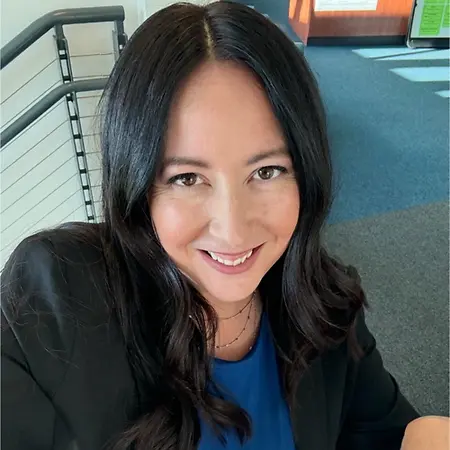
Influential Woman · Education Technology, Social Impact
Jen Elena Romano
Founder and CEO, Cura
San Jose, CA 95125
Her Story
About Jen
Jen Elena Romano is a two-time founder, former chief marketing officer, keynote speaker, and award-winning strategist who has spent more than two decades working at the intersection of business growth and social impact. A first-generation Latina entrepreneur based in San Jose, California, she has helped some of the world's most recognizable organizations, including Google, Wells Fargo, JPMorgan Chase, and Crisis Text Line, develop initiatives that expand access, strengthen communities, and address disparities in wealth and health outcomes. Known for her ability to blend data-driven strategy with authentic storytelling, Romano has built a career centered on creating opportunities for underserved populations while driving meaningful business results.
In 2024, Romano founded Cura, an AI-powered career readiness and workforce development platform designed to bridge the gap between education and employment. Recognizing that many early-career professionals, particularly first-generation and underrepresented talent, enter the workforce without the networks, guidance, or practical preparation they need to succeed, she created Cura to provide accessible career resources, professional development, and employer partnerships. The platform helps emerging professionals build confidence and career skills while enabling organizations to identify and develop untapped talent more effectively in an evolving workplace shaped by both human and artificial intelligence.
Beyond her entrepreneurial work, Romano is a passionate advocate for educational equity and community empowerment. She serves on the board of Sacred Heart Nativity School in San Jose, supporting students from low-income communities throughout their educational journeys and into college. Drawing inspiration from her own experiences as a first-generation professional, she frequently speaks on leadership, career readiness, the future of work, and closing the wealth gap. Whether mentoring emerging leaders, advising organizations, or raising her two sons with her husband, Romano remains committed to opening doors for others and helping the next generation transform potential into opportunity.
Her Interview
Ten minutes with Jen
01What do you attribute your success to?
I attribute my success to immigrant parents, patience, perseverance, grit, and resilience. But it comes from immigrant parents. Watching their journey taught me the value of endurance, the necessity of hard work, and the ability to stay grounded through obstacles, providing me with the foundational blueprint required to build my own career.
02What’s the best career advice you’ve ever received?
The best career advice I have ever received is to be interested and not interesting. Be curious about everybody. Everybody, be curious about everybody. I think that's part of the humble part, right, because if you're not, you sort of go into the room and you think that the person with the biggest title has the most valuable and important things to say. But my experience is I have learned just as much from our interns, from waiters, from receptionists. And so if you are so egotistical and so in your head that you're just focused on that first 5 seconds of shaking the CEO's hand, you're missing all of it. You're missing it. The way that I got the first meeting with the guy from Wells Fargo, I mean, I was a kid, I was in my twenties, cold calling them. But I persisted with his assistant. I said, where are you from? She said, I'm from El Salvador. I said, me too. I said when I come out, you get me a meeting with Danny, I'll bring you pupusas. I said, listen, you know Salvadorians are passionate and determined and hard workers. Just give me 15 minutes on his calendar. We're still friends, and he'll tell the same story. So you think that the way the school taught you or the way that you've seen it in movies or by seeing professionals presented, that there's a way to navigate things, and it's all baloney. It's all human relationships, it's all being open and curious enough to talk to everybody.
03What advice would you give to young women entering your industry?
My advice would be to spend more time with the critical thinking, the deep reflection on what you want to do, on what your strengths are, what your story is. And don't worry about the statistics or what they say, right? Don't pay so much attention to the noise and the trends. The future of work will go to those who can be unapologetically themselves, with confidence in the agency to deeply pursue a problem or a mission that they want to solve. I think of it as think of it less as what the available jobs are and more on what do you want to solve for your career? What are you solving for? Because if you don't have something you're solving for, you'll flounder, and you'll go and you'll never feel that you fit. But when you have something that you're solving for, even if it's not the perfect job, even if it's not the perfect salary, you will find information and knowledge to keep you motivated on your mission. But if you're just doing things and just getting a job because your parents think it'll be impressive to work at Goldman Sachs, then it's going to be a struggle from the beginning. And this is one of, probably, the biggest time in history where your parents don't know what the right path is, universities don't know what the right path is. And so the onus is on the student, the onus is on the young women to find out deeply what motivates you and what you want to pursue. And you will find and create ways, new ways, to monetize and to create sustainable careers if you follow a mission and a problem to solve.
04What are the biggest challenges or opportunities in your field right now?
The biggest challenge is there's so much noise, and everything sounds the same. I think there's a lot of just noise. And sometimes, like, whoever's louder, or whoever spends the most on digital advertising, gets the most credit. The biggest opportunity is there are so many pathways to improve lives, an opportunity to actually change outcomes right now with AI. I hope more people find ways to use it for social impact causes. There's a huge opportunity with it, but also a huge challenge and potential risk of expanding the gap, because the AI is just already trained on existing bias information. Unless you take control over what your LLMs develop and put the guardrails in place, people are not motivated, or there's no regulation for them to do it. And so I think the onus is on us as entrepreneurs to do things in an ethical way that will help close gaps. And not everyone will do that, right? But huge opportunity to leverage technology to benefit people, and I wish more people were talking about that.
05What values are most important to you in your work and personal life?
Humility is most important to me, and not in the humility that's traditionally considered, like, oh, be quiet in rooms, or be shy. The definition of humility that I've come to really anchor myself in is, like, there's all of us have 5 strengths and 5 weaknesses. All of us do. So, get really good at your strengths. Don't worry about your weaknesses. And when you're working with others, recognize that that's what levels the playing field, right? We all do. Don't obsess about your weaknesses, don't obsess about someone else's weaknesses. Like, just be humble enough to know that we all have 5 things we're really good at, and 5 things we're not good at. And you can spend your lifetime trying to improve them, that's fine. But you've been given strengths. And you'll find them if you get connected to who you are as a little kid, those strengths have always been there. They're intrinsic, they're inside of you, and aligning to your strengths will help keep you motivated, because it's really hard to work against the grain. Having humility, you learn to build the teams around you that complement each other. And having humility lets you be in those small groups, which I think is the future of work, right? Small groups with incredibly different skill sets being able to share a mission and work together.
Join Influential Women and start making an impact. Register now.