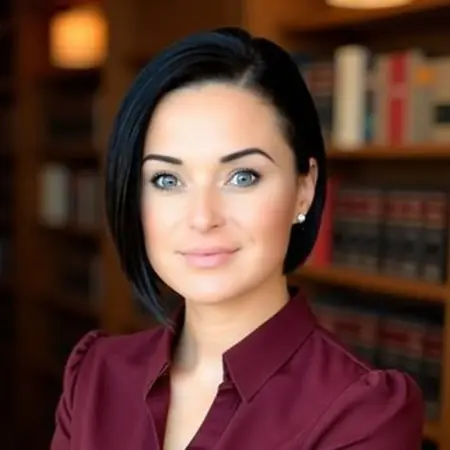
Her Story
About Kaleigh
I moved to Fort Bragg years ago when I got stationed here, and after getting out of the service four years ago, I've dedicated myself to military medical research and supporting the warfighter community. I've been working in this space for about a decade now, building a strong reputation across North Carolina. What drives me is creating innovative solutions in neuroscience that have never been done before. We're working on concepts that multiple generations have kind of skated past, and I'm really excited about putting our thumbprint on something new this year. I'm also deeply involved in a nonprofit that's run by warfighters for warfighters, where we take funds and give them back to the community. We've based our office in one of the lowest-income areas in North Carolina because it's our personal mission to help bring more funds and resources to that area. I've built my career on having compassion as a form of leadership, and I pride myself on having the highest retention rates for veterans. I bring in veterans from different services and backgrounds, and I help bridge the gap between civilian and military structure in a slower-paced environment. My son is alive because of the military healthcare system, so I'll spend the rest of my life giving back to it and helping that system.
Her Interview
Ten minutes with Kaleigh
01What do you attribute your success to?
I attribute my success to the amazing people I keep around me and my strong support system. I realized early on that I am who I am today because of the people around me, and we become a product of our environment. When I was a young soldier, I found very prominent leaders and thought, I'd love to be that way, or be here 5 years from now doing what they're doing. I realized my network and the people around me needed to be people who would help me grow, so I made those hard decisions to surround myself with people that want to see me grow. That, to me, is the most precious gift one person can give to another. I love surrounding myself with strong women, Type A females, because with them I want to be better, but it's not a competition. It's about growing together. I also think my willingness to embrace setbacks and conflicts has been crucial. I enjoy setbacks and conflicts because I feel like I get to grow, and I don't feel like I could grow without those. Growth is not a painless process, it's just like working out. I'm also grateful for everything that happened, including traumatic experiences, because I don't feel like people ever fully grow without them.
02What advice would you give to young women entering your industry?
I would say it's okay to swim against the normal path and be okay walking it alone for a little bit if you need to, to get people that are going to be there to support you. Don't feel limited by what you think you can or can't do. When you get out as a veteran, everything changes and you almost feel like you're alone in the world, but you're not alone and you've got many people here to support you. Surround yourself with people that are going to help you be better, and be completely okay with people telling you that you were wrong. I love surrounding myself with strong women because with them I want to be better, but it's not a competition. In the military, there wasn't a lot of that 'let's grow together' mentality, it was always a competitive nature, but for me, I love strong women. When I have a strong woman next to me, I want to be better. Make those hard decisions about who you surround yourself with. If you want to do better, then surround yourself with people that are going to help you be better. It's okay to make mistakes because you need that. Growth is not a painless process.
03What are the biggest challenges or opportunities in your field right now?
I think the military research space is going to continue to expand pretty extensively and pretty quickly. One of the biggest opportunities is that we're working on concepts in neuroscience that have never been done before, concepts that multiple generations had kind of skated past. Our new model will put our thumbprint on something in ways that's never been done before. There's also a huge opportunity in creating programs for warfighters that don't feel like treatment. I realized when I was gardening that I was going through my own treatment without even realizing it, and I want to put more effort into programs that treat service members in a way where it really resonates with them and it's something that they want to do. I disagree with some of the approaches I've seen in the literature. Warfighters build walls and learn to desensitize themselves for the mission, but we lose some of that connectivity back. I want to bring more horticulture therapy and animal therapy in a way that doesn't feel like treatment and doesn't have a lot of red tape around it. The challenge is that there's not a lot of programs that really create an environment where a veteran can transition. Companies need to be creating programs and environments where veterans can thrive, not removing their identity in the process.
04What values are most important to you in your work and personal life?
The most important values to me are service and giving back. I've lived a life of philanthropy, whether it's my time, my space, or getting the right people that really care. I grew up in an environment where we always put ourselves last and give back what we receive. My family is full of service members, and that's just how we were raised. Compassion as a form of leadership is central to everything I do. I don't do business development, I inspire, and I get people excited to want to help take care of the warfighter and help solve major issues they're going through. I also deeply value creating environments where people and animals feel safe and can thrive. I believe we're guests in nature's environment, so I create spaces where animals feel safe and don't need to scrounge around. I measure our economic footprint and focus on bringing funds and resources to low-income areas and kids. I believe it's easier for a company to change policies than for someone to change their identity, so I focus on creating environments where veterans can thrive without losing who they are. As long as I've got enough money in the bank to feed all the animals, I'm as content as a cucumber. My service is still continuing, it just looks a little different now. We're in civilian clothes, not uniform anymore, but we still operate in the same way.
Join Influential Women and start making an impact. Register now.