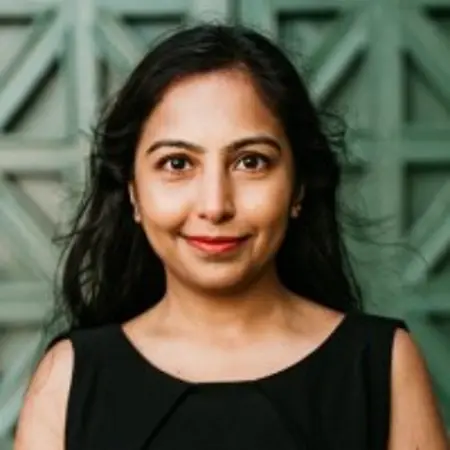
Her Story
About Shruti
I've been working in data engineering for about six and a half years now, though I also worked in business intelligence about four years ago, which is now considered part of data engineering. I started my career at Accenture right out of my undergraduate degree in Electronics and Telecommunications Engineering, but I quickly realized I wanted to pursue higher education. I was interested in business and wanted to come to the U.S. for an MBA or studies that combined business and technology, but due to financial constraints, I completed my MBA in India from 2012 to 2014. During my MBA, I developed an extreme passion for statistics, which eventually translated into analytics and data engineering. After graduating, I became a consultant at Infosys, which was a good mix of business and technology, but I still had that drive to pursue a career in the United States. I wanted to do it from the ground up through education because I believed the master's experience would give me opportunities to meet other students, explore varied career paths, and get guidance from professors. I earned my Master's in Business Analytics in the U.S., and during that time, my favorite subjects were always data engineering related. I did two internships, one at Robotics and one at Keurig Dr. Pepper, both in analytics, which gave me great hands-on experience. Right out of school, I landed a job at Dell as a Business Intelligence Engineer, then moved to a Data Engineer role in my second year. I worked at Dell for six years in the procurement supply chain division, specifically in the procurement space dealing with raw materials, supply, demand, costing, orders, and forecasting, always optimizing for cost savings. I had tremendous opportunities there, primarily because of a great manager who became my mentor for three and a half years. He gave me challenging, ambiguous problems with no blueprint for solving them, which initially made me uncomfortable, but those turned out to be the most impactful projects where I learned the most, especially how to deal with ambiguous problems. I became a team lead at Dell, leading a team of 15 people building data products and datasets for the procurement organization. Last year, I felt I wanted to expand my horizons and take bigger risks while I still had the energy and ambition. I knew Meta was one of the top companies with an awesome data engineering program and career path, and coincidentally, a recruiter reached out to me the same week I was thinking about applying. She had been reaching out for about nine months, but I had just given birth to my baby boy, so the timing finally worked. I interviewed for Meta, and it was truly a family effort because my husband, brother, and mom all took care of the baby while I prepared for a month and went through three rounds of interviews. I joined Meta as a Senior Data Engineer at the IC5 level, which I attribute to the behavioral and project management skills I gained from my mentor at Dell, since Meta's interview process evaluates both technical proficiency and behavioral skills, with the behavioral part determining your job level.
Her Interview
Ten minutes with Shruti
01What do you attribute your success to?
I definitely attribute my success to the mentorship I received, particularly from my manager at Dell who was my mentor for three and a half years. The Meta interview has two parts: the technical side, where they want to know if you're technically proficient, and the behavioral side, which includes business understanding, people management, and project management. The behavioral, non-technical side is what actually decides your job level, because they expect all job levels to be technically proficient. What I gained through my mentor's guidance at Dell made me good at project management, people management, and how to build a structured approach in solving complex or ambiguous problems. Those skills are what got me the senior position at Meta. My mentor gave me challenging, ambiguous problems where there was no blueprint of how to solve them, and while initially it made me super uncomfortable and I thought he was setting me up for failure, those turned out to be the most impactful projects where I learned the most. I learned skills for life, almost, of how to deal with ambiguous problems, and that's what set me up for success.
02What’s the best career advice you’ve ever received?
The best career advice I've received, and this might be a cliche but it's especially true in today's day and age, is to always keep evolving and learning and be open to change. I think that is very important in today's world because of AI everywhere. AI could take over jobs, which would need you to pivot, so you need to be open to pivoting and be open to learning. This advice has become even more relevant now than ever before.
03What advice would you give to young women entering your industry?
My advice to young women entering this field is to really assess their approach to work. Almost biologically, we are trained or conditioned to think and have perspective on things in a certain way. Sheryl Sandberg has given this example many times: if a woman is writing code and her code doesn't work, she'll say 'oh, my code is not working, something is wrong with my code,' but if a guy's code isn't working, he says 'the code is not working,' not 'what am I doing wrong.' So there's always that difference in how we approach problems. I would say really assess your approach to things and compare it with your peers who are male or who are more successful. I do this almost very subconsciously now. You need to identify that women sometimes have a disadvantage. For example, there's a statistical study that proves that men get promoted on potential, but women need to thoroughly prove themselves to get promoted. A woman typically needs to prove her worth that she already is at the next level, but guys can get promoted on potential. So my advice would be to really be aware of the biases that exist in the world and identify your own biases as well, and work on overcoming them. The earlier you can do that, the more it can help your career.
04What are the biggest challenges or opportunities in your field right now?
I think one of the biggest challenges, particularly for women in my field, is the lack of relatable role models. Even when I look at my own workplace or my previous workplace, the ratio between male and female role models is very steep, with the difference becoming even steeper as you go up the ladder. It's very easy to get inspired from someone whom you can really relate to, but there's always a dearth of relatability in that sense. By relatability, I mean someone who also has a kid like me, someone who has a similar background as me, and who is really up there in leadership. I'm not saying they're not there - there are of course many women killing it - but the ratio of male to female leaders, especially as you go up the ladder, is really steep. This is definitely one of the challenges because, generally speaking, women are so much more intelligent than men, they're great multitaskers, they're great at making things happen and making ends meet even in adversity. But when it comes to the workplace, I think the risk appetite of men is higher, which actually goes back to biology. Men were hunters going out hunting for food, so they actually have a higher appetite for risk because they have to be the providers. But women were supposed to be in the household, make do of what is there, be scared that intruders shouldn't come in, always protecting. This awareness of these biological differences is what will help us change our wiring.
05What values are most important to you in your work and personal life?
I would definitely say trust and reliability are most important to me. These are also one of my USPs and one of my biggest values at any workplace I've worked at. I think it's very important to develop trust with yourself and your colleagues or your cross-functional partners. You need to position yourself and build your credibility to a point where people can absolutely rely on you to get whatever task done. Credibility, trust, and reliability are the values that I feel very strongly about and work on every single day, almost.
Join Influential Women and start making an impact. Register now.