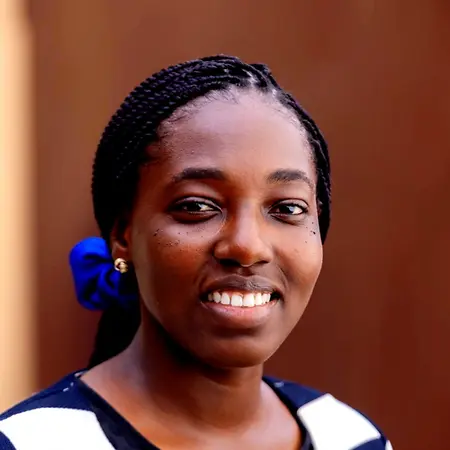
Her Story
About Susan
My journey into public health research began with my father's two-decade struggle with diabetes, which sparked my interest in health careers. I started as a laboratory scientist in Ghana, earning my Bachelor's in Medical Laboratory Sciences from Kwame Nkrumah University of Science and Technology and working for four years at Lancet Laboratories. When COVID-19 hit and everything came to a standstill, it gave me room for self-reflection, and I knew I had to do something directly impactful, touching people's lives. This led me to pursue my master's in public health at the University of Nevada, Las Vegas, specializing in social and behavioral research with a focus on maternal and child health. My thesis delved into food insecurity affecting pregnant women and nursing mothers, which really showed me there's no going back. Understanding that pregnancy is such a vulnerable time, and seeing how it gets more complicated when women can't even afford food for themselves or their growing baby, drove me forward. Now I work as a research analyst at the Nevada Institute of Child Research and Policy, where I'm building expertise in child safety and advocacy. I believe all children should have a wonderful, innocent childhood and shouldn't be exposed to life's harshness until they're truly enabled to face those challenges. On a day-to-day basis, I review research papers, interview providers across Nevada about challenges in protecting children from maltreatment, and work on providing resources to parents through legislation and advocacy so families and kids can be safe.
Her Interview
Ten minutes with Susan
01What do you attribute your success to?
I definitely can't take God out of that. First of all, I would say God, and then definitely just having a dogged mindset of there's no giving up. Those two are my top two - my faith and my determination to never give up no matter what challenges I face.
02What’s the best career advice you’ve ever received?
The best career advice I've ever received came from my mentor, Dr. Buccini, who was my supervisor during graduate school. She told me that you have to trust the process and work hard to achieve your goals. So far, it's been helping me, and I'm looking forward to what the future leads.
03What advice would you give to young women entering your industry?
I will say, though the climate now, especially, doesn't seem to encourage anyone, it's to not give up, and it's to work as though every day may be a day of a new discovery. You know, women's health did not become a forefront topic until it did. It's people who cared consistently, writing on women's health, who cared consistently advocating for it, that have brought it this far. So there's no giving up. That's what you're forging right here.
04What are the biggest challenges or opportunities in your field right now?
The challenges are definitely the changes at the federal level that keep affecting us in so many ways. Funding priorities are being shifted in areas where you once thought this can definitely never go unfunded. We've seen that vulnerable people and communities that once actually needed the help twice as much are being overlooked or cast to the side based on shifting priorities. That's one of the key challenges of our times. Professionally, there's a lot of struggle as to what do we do with all this happening, so it's just that uncertainty over time.
05What values are most important to you in your work and personal life?
Professionally, I would always say that public health is a space where you need to be empathetic. As a research analyst, you are quick to see numbers instead of people. You're quick to see trends instead of the fact that this is an outcome of someone's life. So it's less about what the percentage is, what the graphs and charts are saying, but more about how these charts are actually changing people's lives. I always try to put myself in that space, that this is a life that is being changed by the power of research. For my personal life, I would say that definitely God is above everything. I'm a firm believer that he's the one who creates our path, and no matter what we see, he's always there to help.
Join Influential Women and start making an impact. Register now.