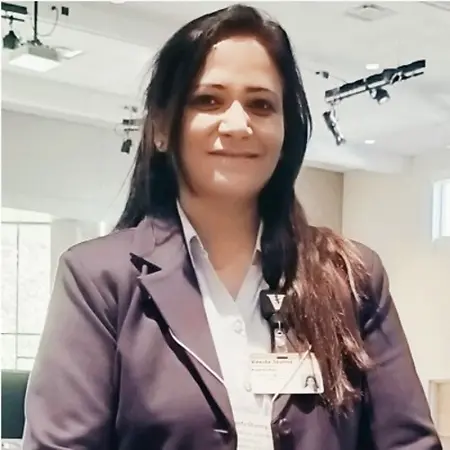
Her Story
About Vineeta
My journey in science has been both deeply personal and transformative. I earned my Ph.D. in India in 2018, where my research focused on women's reproductive health, particularly reproductive tract infections, human papillomavirus (HPV), and the progression toward cervical cancer. During my doctoral research, I identified a novel cytokine gene variant with potential as a biomarker for cervical cancer, an experience that strengthened my passion for translational biomedical research.
Beyond the scientific discoveries, it was my interaction with HIV-positive women during my doctoral studies that profoundly shaped my perspective. Working closely with these patients, I witnessed their resilience, courage, and determination despite the tremendous physical and emotional challenges they faced. Their strength inspired me to realize that life is defined not by obstacles but by purpose. That experience reinforced my commitment to dedicate my career to scientific research that has the potential to improve human health, particularly the health of women.
Following my doctoral training, I moved to the United States to pursue postdoctoral research at Vanderbilt University, where I expanded my expertise in cancer biology and received advanced training in state-of-the-art molecular and imaging technologies. This experience provided me with a strong foundation in translational cancer research and exposed me to innovative approaches for understanding disease mechanisms.
I later joined Meharry Medical College as a Senior Staff Scientist in the Morphology Core Facility. In this role, I support faculty, postdoctoral fellows, graduate students, and medical students by providing scientific consultation, developing experimental strategies, training researchers in advanced imaging technologies, and contributing to a wide range of collaborative biomedical research projects. My expertise encompasses advanced microscopy, cell and developmental biology, three-dimensional cell culture, and quantitative image analysis. My current research focuses on triple-negative breast cancer using patient-relevant three-dimensional organoid models and high-resolution imaging platforms, including confocal and super-resolution STORM microscopy, to better understand tumor progression and evaluate novel therapeutic strategies. I have established advanced 3D organoid culture techniques that closely recapitulate the biology of human tumors, creating valuable experimental models for cancer research and drug discovery.
Looking toward the future, my vision is to establish a nationally recognized organoid research and development center capable of generating high-quality organoid models for academic investigators, pharmaceutical companies, and biotechnology partners to accelerate drug discovery and precision medicine. I believe that integrating organoid technology with advanced imaging and translational research has tremendous potential to transform the way we study disease and develop more effective therapies.
Throughout my career, my greatest motivation has remained improving women's health through scientific discovery. Equally rewarding has been the opportunity to mentor and learn alongside students and young investigators, helping them develop confidence and technical expertise while continuing to grow as a scientist myself. I am deeply grateful to Meharry Medical College for providing an environment that supports innovation, collaboration, and scientific excellence, allowing me to contribute meaningfully to biomedical research and to the next generation of scientists.
Her Interview
Ten minutes with Vineeta
01What do you attribute your success to?
I attribute my success as a scientist to a life-changing personal experience. In 2014, shortly after beginning my Ph.D. and while raising my young daughter, I faced a serious personal tragedy that made me question whether I could continue pursuing my goals. During my doctoral research on women's reproductive infections, I worked closely with women living with HIV. Witnessing their remarkable resilience despite immense physical and emotional challenges transformed my perspective. Their strength inspired me to persevere and dedicate my career to improving women's health through scientific research.
This experience became the foundation of my scientific journey. During my Ph.D., I identified a novel biomarker with potential relevance to cervical cancer, which sparked my long-term commitment to cancer research. Today, my work focuses on breast cancer, where I have established advanced three-dimensional organoid models that closely mimic human tumors and apply cutting-edge microscopy technologies to better understand cancer progression and evaluate new therapeutic strategies.
My lifelong goal has been to improve women's health through translational research. Every step of my career has been driven by the belief that scientific discoveries can ultimately lead to better outcomes and a healthier future for women worldwide.
02What’s the best career advice you’ve ever received?
The best career advice I can offer is to stay curious, believe in yourself, and never be afraid to pursue your ambitions. Whether in science or any other profession, success requires persistence, resilience, and confidence in your abilities. Challenges are inevitable, especially at the beginning of your career, but they should never define your future. Instead, let them strengthen your determination.
Equally important is seeking mentors and building a supportive professional network. The guidance and encouragement of experienced mentors can have a lasting impact on both your personal and professional growth.
My own journey was far from easy. I began my career during one of the most difficult periods of my life, but I remained committed to my goals. I was fortunate to pursue my doctoral training, followed by postdoctoral research at Vanderbilt University, where I gained advanced expertise in cancer biology and cutting-edge biomedical research techniques. Today, I serve as a Senior Staff Scientist at Meharry Medical College, where I continue to learn, collaborate, mentor, and contribute to research every day.
To every woman pursuing her dreams, my message is simple: believe in yourself, remain patient, and never give up. Every challenge is an opportunity to grow, and every setback brings you closer to success. Keep moving forward with confidence and determination—one day, you will achieve the goals you have worked so hard to reach.
03What are the biggest challenges or opportunities in your field right now?
One of the biggest challenges in my field is developing and maintaining three-dimensional organoid models that accurately mimic human tumors. These systems are expensive, technically demanding, and highly susceptible to contamination, requiring specialized expertise, infrastructure, and significant time to produce reliable results.
My goal is to establish a nationally recognized organoid core facility that supports cancer research and drug discovery. With continued funding, collaboration, and innovation, I hope to expand access to this technology and accelerate the development of more effective therapies for cancer patients.
Join Influential Women and start making an impact. Register now.