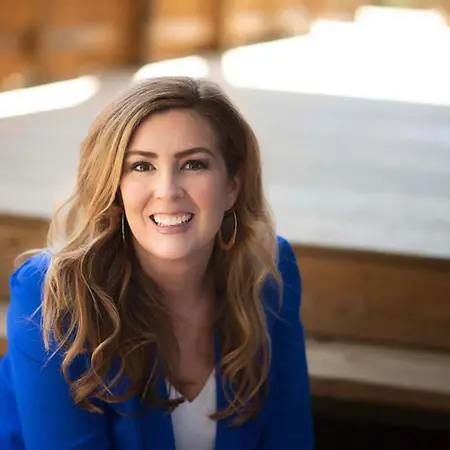
Her Story
About Brittany
I was drawn to education because I had family members who were in careers or pathways that were community-based. I had teachers in my family, family members in public service, and family members in religious fields as ministers, so everyone was in a service role. Even my grandmother, who never finished 8th grade because we came from a very rural part of West Virginia, was involved with registering women to vote. My other grandmother was in an elected position as town clerk or county clerk, and my grandfather drove a school bus, drove an ambulance, and was on the town council. My father was a minister of a very rural church for many years, serving to help members of the community in every way you can imagine. So it was very much a whole area of my family that was involved in serving the community in one way or the other, and that was a natural fit for me. I started out in K-12 education and then moved into community college and adult education. Over time, I moved into online education, but now I look back and I think it's all come together because so much of community college education and higher education has shifted to include dual enrollment programs and high school programs while still serving adults. When 2020 happened, it wasn't really a matter of specializing in online education anymore because the whole world became one world, and everyone needs to be an expert in online education now. Teachers have a tremendous amount of pressure on them to go deep and wide at the same time. My area of expertise is really helping other teachers learn the value of quality online instruction and being adaptable to technology and software, while understanding and bringing the timeless value of liberal arts education into that futuristic, online, micro-credential world.
Her Interview
Ten minutes with Brittany
01What do you attribute your success to?
I think any success I have is absolutely just due to my faith, my family, everything that's been given. I've been very blessed. My parents were, you know, my dad, I think my parents' combined income from at least the first part of my life till I was about ten was like $10,000 a year. I mean, we just did not make anything. But my family, they were just the best. They were always working hard, and caring, and reading books to me. Wonderful family.
02What’s the best career advice you’ve ever received?
When I became a department chair and was doing hiring and learning to lead other faculty members, the woman who was kind of mentoring me unofficially said, always keep a post-it note around your computer that says, how are the faculty feeling right now? With a question mark. She said, because as you move up in your leadership and you get further away from the people, from the jobs of the people you're leading, you forget how they're feeling in the moment. And losing that ability to remember how they're feeling in that moment can really hurt you as a leader because you get so disconnected from that soldier on the front lines kind of thing. So that has really stuck with me. It's just pausing for a minute and asking myself, how are the students feeling right now? How are the faculty I'm serving feeling right now? And then even at ITC, asking myself, like, how might the members of our organization be feeling right now? And that's true for when something happens in the world that involves education or something happens technology-wise. I can feel that anxiety and confusion might be raising, and I have to pause for a second and realize maybe I'm not feeling anxious, maybe I'm good, but it really, it's not about you. It's about how's everybody else feeling. Just remembering that and then responding accordingly has helped keep me grounded.
03What advice would you give to young women entering your industry?
Adaptability. Work, know your strengths. And if your strength is not adaptability, work on that strength. You know, know yourself. And work on building up a genuine network of colleagues.
04What are the biggest challenges or opportunities in your field right now?
I think the biggest challenge right now is navigating AI without losing your sense of hope and your sense of dedication to your field. The opportunities right now are that there are so many new schools being formed, and that's at all levels, K-12, university, trade schools, tutoring programs, I mean, just micro schools, hybrid schools. There's just a lot of new things being formed. And entrepreneurship is really on the rise. So there's just a lot of opportunities to, kind of, what's your idea and build it.
05What values are most important to you in your work and personal life?
I think it's really, really important to be oriented to the individual. That's of value to me, and I realize that sounds crazy to say as an educator. You can't always orient to the individual. That does not always work. But when you are able to listen to an individual concern, or an individual situation, or you're able to adapt to an individual request, I have, I've almost never regretted that. But when I have just said a quick no without considering that request, I've often regretted not trying to go that extra mile. So I try to stay oriented to individual needs, even if I can't always meet the individual needs. If a student emails me and said, you know, I've missed 5 deadlines, can you let me retake half the course? I can't meet that individual need. But if I stay oriented to the individual, I can at least say, I'm sorry, I can't let you retake all of that content. However, here's what I can do. And I try to meet them, meet the need in some way, saying, you know, I hear what you're saying. Here's what I can do. I can let you maybe make up the last assignment if you'll agree to do this and still follow my standards. But try to stay oriented to listening to the individual without just a quick no. I think that they pick up from me that I am on their side, that I do care about them. I am here for them, and I'm not here against them. And that's a big difference. And I think that's maybe a principle from Zig Ziglar, when he talks about, you know, if you help enough people get what they want, you in turn will get where you want to go. And I think that's what I'm getting at with that value. Even if it's not with students, even if it's just with colleagues, when they make a request of you, if you do whatever you can to help that person, they learn to rely on you. They learn that you're a person who cares about them on an individual level, you really build up a reputation for caring about folks. And that goes such a long way. You know, you can always count on them to remember you and what you did for them. And you can call on them, you know, 20 years down the road.
Join Influential Women and start making an impact. Register now.