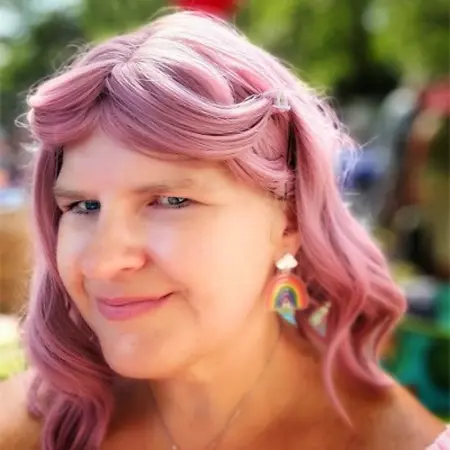
Her Story
About Jennifer
I grew up in the Shenandoah Valley and was the first in my family to go to and graduate college. I worked my way through George Mason University by working full-time at Blockbuster Video, often working until 1AM training people and then doing homework. After graduating with a creative writing degree in 2006, I went into marketing for a GPS company. Just before the 2008 recession, I found a job at Greenpeace as an administrator for their face-to-face fundraising program. I discovered that face-to-face fundraising is the most powerful form of fundraising because human interaction can get people from 0 to 5 touches of trust in a 10-minute conversation. What makes me different is that I worked in an in-house program that taught me not just the business side, but also how to do the work in the field myself. I can manage both the number of articles and the machine that prints them, so to speak. In November 2018, Children International asked me to relaunch their face-to-face program in a very intentional, ethical way. In 2020, when everything shut down, I was one of the first to bring fundraisers back to work safely outdoors with PPE. I helped put as many fundraising companies back to work as possible, and not a single person got sick on the job. I run my program rooted in ethical fundraising practices, ensuring all my fundraisers have access to hourly wages that cover their basic needs, with bonuses as extra motivation rather than survival. My program has one of the best retentions in the nation because it's a true partnership.
Her Interview
Ten minutes with Jennifer
01What do you attribute your success to?
I can attribute some of it to family support. My family didn't have much, but everything that could have been given to me was given wholeheartedly. I was also blessed with a grandmother who recognized that I have kind of a special brain, and she made sure we had access to things like the library. She lived in a city and would take me to her city library, which had the information for whatever obsession topic of the day I had. But at the end of the day, a lot of it I attribute to just a decision I made at 8 years old. I don't remember why it was the thought, but I remember I was in my dad's car, we were on the way back home, and I just had this thought, which was that I don't want to have to struggle the way that I've seen other people in my life struggle, and I want to do everything that I can to make that not the case. I'm very much where I am today because I was like, I want more, and fought for it.
02What’s the best career advice you’ve ever received?
The best advice, which I now give to others, is to really stay positive. You're gonna hit points where nothing works out and it gets really, really hard, but the thing that is between you and the thing that you most want in the world, if you just stay positive, maybe it doesn't come today. Like me and my house in the Outer Banks, I lost my home 7 years ago, and even though it was like, COVID, not happening, and the next year definitely not happening, and the year after probably not happening, I was like, at some point in my life, it'll happen, so I'm gonna stay positive and know that I will go home. That's why I moved to the road and was a nomad for 2 years, because I want to live on an island that's only accessible by boat, and when I get home, it's gonna be very expensive for that reason. I didn't want to ever sit down and worry or wonder about the things I didn't do when I had the chance. If you think about where I come from, nothing about my life is what would have been predestined for me if I just rolled with it. If I had believed what has been told about me, I wouldn't be here right now. But I was like, I don't believe that, I'm gonna work really, really hard. If you just continue to keep your goal as your goal and do everything you can in between, if it's your goal, you'll get there, so long as you don't give up on it. If you give up, once you give up on it, you're never gonna have it.
03What are the biggest challenges or opportunities in your field right now?
In my field, I think the biggest challenge is trust. Before I can even have a conversation about what my organization does to figure out if it aligns with someone's values, I have to prove to them somehow that I actually do work for them. That piece can be very difficult, especially as more people do things that are not to everyone's benefit. Decisions that negatively impact everyone, whether it's people not fundraising ethically or scam callers, erode people's trust not just in you as a person, but in the system as a whole. I think the challenge is that I have to try twice as hard as someone who isn't on the level to prove that I'm on the level, because of the ones who aren't on the level. My biggest challenge is that too many of my peers are investing in this other model of fundraising, which is often commission-only environments where people will make bad choices if their entire paycheck is commissioned because they gotta eat. My peers don't always seem to understand that the reason why they're not getting the best quality donors is probably because they're not paying for them. And the ones they are paying, or their bad hiring practices and bad ethics in the field, punish all of us. People lump nonprofits together, whether we operate together or not. So if one's shady, then everybody's shady. People will continue to treat my fundraisers poorly even if they are good kids doing the right thing, because they look like the bad thing.
04What values are most important to you in your work and personal life?
The two biggest values for me are equity and justice. When it comes to my fundraising program, I try to make sure that my decisions are not going to negatively impact someone who has less than I do. Because at the end of the day, I want to, as best I can, create space for everyone to be as equal as we can make it. And then justice, I want things to be not only equal, but also fair. When people are dishonest or lying, my ADHD is one of the things that kind of drives my intense sense of justice, where if it's not fair, or if it's not right, then it's not okay. Those are the two things I'm constantly fighting for, trying to level the playing field so that we can all see above the fence.
Join Influential Women and start making an impact. Register now.