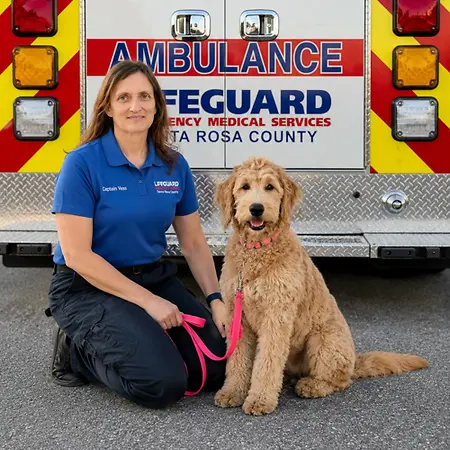
Her Story
About Deana
Deana Vess is a seasoned emergency medical services leader, paramedic, and operations professional with more than 20 years of experience advancing patient care, operational excellence, and workforce development in pre-hospital medicine. As Operations Manager at Lifeguard Ambulance Service, she oversees daily operations, staffing, training, and strategic initiatives designed to enhance service delivery and clinical outcomes. Known for her collaborative leadership style and commitment to continuous improvement, Deana plays a key role in ensuring emergency response teams are equipped to meet the evolving demands of healthcare while maintaining the highest standards of patient care and operational accountability.
Throughout her career, Deana has combined frontline clinical expertise with a passion for leadership and program development. A nationally registered paramedic and certified community paramedic, she has led teams through complex operational challenges while championing ongoing education and professional development for EMTs and paramedics. In addition to managing multiple operational divisions, she has been instrumental in developing innovative programs, including mobile integrated health and community paramedicine initiatives designed to expand access to care and improve health outcomes beyond traditional emergency response services. Her dedication to excellence extends to special projects, organizational growth, and the implementation of new healthcare delivery models.
A lifelong learner, Deana is currently completing her Master of Public Health degree, further strengthening her ability to influence healthcare systems and community wellness initiatives. She is also deeply committed to supporting the mental health and resilience of first responders through her peer support and crisis intervention certifications. Beyond her operational responsibilities, Deana serves as a therapy dog handler alongside her golden doodle, Langley, providing comfort and emotional support to first responders and communities experiencing crisis throughout the Florida Panhandle and North Alabama. Her career reflects a steadfast commitment to service, leadership, and improving the lives of both patients and the professionals who care for them.
Her Interview
Ten minutes with Deana
01What do you attribute your success to?
I attribute my success to just not giving up and just pushing forward. You know, you're going to learn from your mistakes when you fall. You're going to have things that aren't necessarily successes, but use that to help yourself grow and continue on, and just don't give up, keep going. It's about perseverance and using every setback as an opportunity to learn and become better at what you do.
02What’s the best career advice you’ve ever received?
The best career advice I ever received came from my regional director when he first stepped into his role. He basically told me to not be afraid to just take the shot. Don't overthink it, and you know, if you have a good idea that something will work, go ahead and just take a shot. You really can get bogged down in the what-ifs, and let me ask this person, and let me ask that person's opinion. That's not to say don't ask your mentors for advice, but don't get bogged down in those little details. Once you have the idea on the direction you want to go, go ahead and take the leap, make the opportunity happen for you, and go forward from there.
03What advice would you give to young women entering your industry?
My advice to young women entering this field is to respect yourself and find a good mentor to help lead you up. Pre-hospital medicine and emergency medicine is a hard field. It's still considered a predominantly male field, even though women really are starting to outnumber the men. But you want to attach yourself to a good mentor to lead yourself up and follow their lead as you go along. Having that guidance and support is crucial in navigating this challenging but rewarding career path.
04What are the biggest challenges or opportunities in your field right now?
I think for our field, one of the biggest challenges we have is our reimbursements. EMS reimbursement is a major issue because EMS is an afterthought. Nobody thinks about needing an ambulance or emergency medicine until it's time for them to need it, so we're kind of an afterthought. We're really trying to make some inroads on getting good legislation at the national level so we can have better reimbursements to help make it sustainable. All over the country, EMS operations are shutting down because they just don't have funding. We're the last thing a county wants to fund. Firefighters get funding, police get funding, and then when it comes time to fund EMS, it really is the last thing on anybody's mind. That's probably our greatest challenge there, just having sustainable funding. We're pushing forward with national legislation to get paid to treat patients in place. Currently, at least in Florida, if we go and provide treatment at somebody's house but don't transport to the hospital, there's not a great pathway for us to get paid to do that, so we'll be providing that service for free in a lot of cases. Another big challenge is that EMS still falls under the Department of Transportation. When it was first set up 50 years ago, it got set up under the Department of Transportation, so we're really actually grouped with truck drivers and long-haul drivers. We need to get out of the Department of Transportation and get treated as a healthcare organization. We do so much more than just transport patients. We give blood in the field, we're basically mobile emergency rooms. So many times we're going to do the same thing the doctors are going to do in the emergency room, we're just going to take it to the field and then take it to the hospital. Once we can get past that mindset that we're no longer part of DOT, that'll really help change the way it's viewed.
05What values are most important to you in your work and personal life?
The values most important to me in my work and personal life are what we call CPR, which stands for compassion, professionalism, and respect. I'm going to steal this straight from our HR rep because it ties into our career field perfectly. We want to lead and bring forth and provide CPR to the people that we encounter every day. As long as you can lead and provide compassion, professionalism, and respect to the people that you encounter, you're going to be successful in anything that you do.
Join Influential Women and start making an impact. Register now.