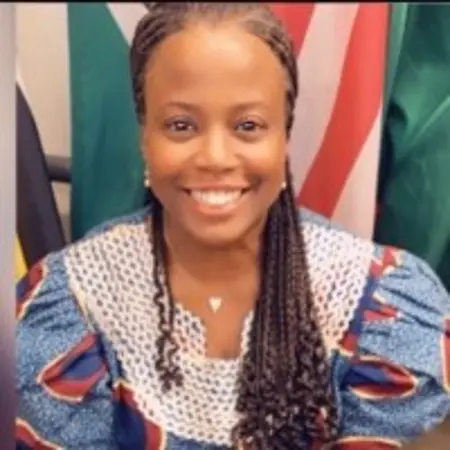
Her Story
About Kathia
I've been in education for over 20 years, though my journey started with a different dream. I originally wanted to go into law, specifically labor law, because I saw so much injustice and wanted to focus on equity in labor. I worked as a social worker and child advocate, and growing up, my sister and I helped immigrants in my mother's Haitian church community in Philadelphia. We taught them how to acculturate, taught English classes, helped with resumes and job applications, and translated documents for French speakers. I was doing all of this at age 14. I learned Haitian Creole through hymn books and church pamphlets, then bought a Haitian dictionary to continue learning. I ended up getting my Master's of Science in Education at St. Joe's, focusing on public policy and language policy, because I realized that language is a huge barrier for people coming from other countries, and globally, language can be a barrier. After working in Haiti with Deep Springs International on clean water initiatives, where I dealt with compliance and humanitarian development issues, my mother fell ill with breast cancer and I came back to care for her. I've taught in both public and independent schools, and I'm certified in International Baccalaureate for 10 years, doing IB training for teachers on second language acquisition. My biggest achievement was implementing the Hughes Travelers program in 1999 at Langston Hughes Middle School, where I took 37 middle school students to France and Spain. I was only 26 years old, and it was the first time we did IB in the school. That trip was a turning point for me because my whole philosophy is preparing students to compete globally, helping them understand we are a global village. I live on campus at my current school, which is unusual because normally students live on campus and teachers go home, but here it's reversed.
Her Interview
Ten minutes with Kathia
01What do you attribute your success to?
I set small goals for myself and I always compete against my own score, not anyone else's. I used to run track in high school, and I always said, I don't compete in anyone's lane. I compete against my own score. I don't compare myself to anybody else. When I first started teaching, I asked my principal to sit in and give me feedback, and she told me if I did certain things, I could improve. So I would set that as my benchmark to hit that target. Once I hit it, then I move up and try the next target. I basically compete against myself. I was very hard on myself because if I couldn't reach every child, I felt I was failing. But Sister Carmela told me, no, you can't do that, you have to try to reach the high average or you're gonna burn out too quickly. I never forgot her saying that. My teachers, like Madame Colligno who I shadowed during student teaching at Overbrook High School, taught me to do it small, bit by bit. That incremental approach, always reflecting on my process and learning from feedback, is what has helped me grow throughout my career.
02What advice would you give to young women entering your industry?
The first thing I ask is, why do you want to teach? Because teaching, to me, is not a profession, it's a calling. You are not appreciated for what you do. Your ideas are always stolen. I'm being brutally honest. But I always tell students, God gave you that idea so you can recreate it. They probably don't even know what to do with it, so keep going. I've gotten so used to people taking your idea, taking your word of the week, taking this, taking that, because I've come to realize that it's been done somewhere on this earth, I just don't know about it. When you go into teaching, I always tell them, be ready to have a thick skin. But always remember who your clients are. They're not the principals and the administrators. Your clients are the students, the people that you're teaching, and the parents. That's it. Some administrator was like, hey, what about us? I'm like, well, you make sure the environment stays safe, but in all reality, my clients are my students, the ones who walk through my door every day, along with their parents. If you're not ready to realize that the parents and the students are your clients, then I don't think you should be in the profession. If they didn't have children, you wouldn't have a job. If you don't have a tough skin, this isn't the profession for you. If you're not willing to work outside of 7 to 3, it's not a profession for you, because it's never done. You have to really want to do it. You have to be motivated beyond what you see, and remember your clients are not policy makers or politicians or administrators. It's really the people who bring their child and entrust their child to you.
03What are the biggest challenges or opportunities in your field right now?
Kids have no sense of ethics. They don't even know what respect is anymore. I'm having to teach them how to think. My friend said, but Kat, you're teaching them how to think. They don't know basic cognitive skills like reading, breaking things down, following instructions. Whether you're in the inner city with no supervision and no one's home, or in the most affluent area with no supervision and no one's home, you're dealing with a different form of latchkey kids. We were more independent, we figured it out, we read, we applied what we learned. These students do not know how to apply what they learned, because really, there's no one to teach them how to apply what they have learned. Education is moving so fast that if you don't do it after school or in between times, they're figuring it out and thinking, oh, okay, this is good. But how do you assess what is good or not? The reflective piece is what's missing a lot in education. We have to reflect upon everything. The nuns made you reflect, whether you wanted to or not. I have my students reflect upon everything they do. We just wrapped up a project, let's write about the process. What did you do? What worked? What didn't work? Why? How did you feel? Why did you feel this way? And now let's look at the whole thing. They start really reflecting, because we're not given time to think and reflect. Everything's becoming extremely transactional and not enough time to process the transformation and process that we're going through.
04What values are most important to you in your work and personal life?
Education begins at home. The basic aspect of education, theoretically speaking, comes from your mother, the first people who teach you, and you carry that with you throughout your learning process. My mother built integrity in us. She would say, if I'm not watching you, God is. That built the integrity, because it comes back. She taught us to be independent, but not so independent that we forgot how our actions impact other people's actions. If it's not good for your siblings, it's not good for you. That's how you learn integrity and ethics. My mother said she sent us to the nuns because they mirror the values and the character that she wants to form in us, and what they are mirroring aligns with what she is teaching us at home. I hold true to what my mom said: education begins at home. The bulk of my education really was from home and church. I don't compete in anyone's lane. I compete against my own score. I always remember who my clients are, the students and parents who entrust their children to me. My whole philosophy is preparing students to compete globally, understanding that we are a global village. Language and communication are the center peg of how we communicate everything, and it's how we help students see how everything is connected.
Join Influential Women and start making an impact. Register now.